Fredericksburg was one of the most disastrous battles in American military history. It was a debacle that sank the North into its lowest state of morale of the war and led Union soldiers to desert in droves. It didn’t have to be. I have visited here several times and keep saying I am going back to walk to trails and I just haven’t made it yet but it is on the docket so more pictures will be coming.
Anyway following George McClellan’s refusal to move after Antietam Abraham Lincoln was growing tired of McClellan. McClellan did eventually move but not as fast as Lincoln liked so the decision was made to replace him with Ambrose Burnside. Burnside was a West Point trained soldier but had entered civilian life before the war. He was a moderate entrepreneur, most famous for inventing a repeating carbine that he tried to sell to the army, and a politician. When the war broke out he was in charge of an amphibious attack on New Bern, NC that was one of the early successes of the war and he rode that to command of the IX Corps. Burnside took command of the Army of the Potomac on November 7.
Lincoln wanted an aggressive movement from his armies. U.S. Grant with thr Army of the Tennessee was urged to move on Vicksburg, William Rosecrans with the Army of the Cumberland was urged to move on Chattanooga and Burnside was urged to move on Richmond. Burnside devised a plan that relied on quick movement and deception by feigning a movement southwest and then moving south to cross the Rappahannock River. The plan relied on Lee being kept in the dark and for all moving parts to move at the proper time. Lincoln had doubts but Burnside’s plan was reluctantly approved. A supply base was established at Falmouth and the movement began on November 15.
The plan went wrong immediately. Burnside ordered pontoon bridges sent forward for a crossing of the Rappahannock River but the bridges were not ready to go. He had been told that they were ready but the bridges were still in use on the Potomac when the movement began. There were also a lack of horses to move the bridges. Burnside assumed that the issues would be ironed out quickly but they weren’t.
Edwin Sumner’s II Corps was the first to arrive at Fredericksburg and found only 500 Confederates guarding the town. He urged crossing his men but Burnside held him back. He was worried that fall rains would made the river prone to flooding and the corps would be trapped on the other side potentially. Sumner would have to wait.
When Lee received word that Burnside was moving but he did not think that he could beat him to the Rappahannock and instead planned to fight along the North Anna River. Burnside’s slow movement changed his mind and he moved to the Rappahannock instead. On November 23 James Longstreet’s Corps arrived and took up position on Marye’s Heights beyond the town. Lee himself had spent time in Fredericksburg in his youth and he knew the area well. Stonewall Jackson arrived on November 29 and was positioned to the south the prevent a crossing of the river south of town as far as Port Royal 18 miles away.
The pontoon bridge finally arrived on November 25 and while he could not cross unopposed only half of Lee’s army was present and it had not yet dug in. Burnside decided to wait for the remaining bridges so that he could cross his men all at once. He wanted to cross the river a few miles down but by the time he was ready Jackson’s men were guarding the crossings. He believed that Lee had weakened his force near the town so he decided to make the attack there. To soften up Lee’s men and to prevent any major counter attack he had 220 artillery pieces placed on Stafford Heights just across the river.
Burnside organized his army into 3 Grand Divisions under Sumner (II and IX Corps), Joseph Hooker (III and V Corps) and William Franklin (I and VI Corps) with a reserve corps (XI) under Franz Sigel. He had 120,000 men, most of whom were veteran soldiers.
Before dawn on December 11 Union engineers moved the pontoons to the river and began assembling them, six bridges in total. As soon as daylight broke they came under fire from Mississippians across the river under William Barksdale. Burnside’s artillery on Stafford Heights opened up but was ineffective. Infantry was then loaded onto boats and sent across the river. 3 regiments were crossed and house-to-house fighting began around 3 PM. The bridges were completed around 4:30 PM and Sumner’s men were the first to cross.
Sumner’s men went to work clearing the town in some of the first urban combat in the war. By nightfall the Union was in control of the town and the soldiers set to work looting. Many of Lee’s men, especially Virginians, were incensed and many of the Union troops following were shocked at what they saw.
December 12 was used for more troops to cross the river and these continued into the 13th. Jackson recalled his men and moved them to Fredericksburg. Burnside planned for an attack on the 13th with Franklin’s Grand Division against Jackson. Franklin assumed it would be with his whole force of nearly 60,000 men but when Burnside’s order reached him at 7:45 AM it called for only one division to move and capture Prospect Hill. Sumner was just to extend his flank. Some historians believe that Burnside was trying to intimidate Lee to force him to retreat but Lee was in a strong position and he knew it.
December 13 was cold and overcast with a dense fog in the morning. George Meade’s Pennsylvania Reserves Division was selected to assault Prospect Hill with John Gibbon’s division in support. Meade advanced at 8:30 AM. As the fog lifted his men came under fire from John Pelham’s Horse Artillery around 10:30. Abner Doubleday’s division was moved to counter this but Pelham remained under he ran out of ammunition.
Confederate artillery at first stalled Meade but when Union artillery ceased firing his men went forward at around 1 PM. Jackson had 35,000 men in line and Meade had 4,500 but Jackson’s line had a flaw in its deployment with a patch of which was swampy and thick with underbrush. No one guarded this gap of about 600 yards and Meade was heading right for it. Meade’s men quickly widened the breach and captured many Confederates who had stacked their rifles to take cover from the artillery. Others called for help and hand-to-hand combat began. Meade’s men were running low on ammunition and help was not forthcoming and inevitably Jackson’s men closed in around Meade who eventually had to retreat. Gibbon had moved forward and had engaged the Confederates but his men took heavy losses and pulled back and no other support was coming. A Confederate counter-attack was repulsed by troops who Meade was trying to move to the assault to save his command and Union artillery dissuaded Jackson from trying again.
The fighting now moved north to Burnside who at first attacked Marye’s Heights as a diversion. Marye’s Heights is a high, open ridge west of town. The Confederates had it well fortified. “A chicken could not live on that field” E.P. Alexander, one of Longstreet’s artillery officers said of it. A sunken road with a stone wall offered a natural trench and breastworks and abatis had been constructed. Sumner’s II Corps would be first to assault it at noon. The attack stalled about 40 yards out and casualties were high in the first assault. The II Corps continued to assault it with the same result each time. The Union soldiers attacked in formation and would stop to reload making them easy targets. One division commander urged a bayonet charge but wa told not to. The II Corps lost 4,000 men that day.
Longstreet’s men holding the wall took few losses. Ammunition ran low and the defenders moved out and were replaced by reserves. Burnside, aware of the heavy losses, did not change tactics. Franklin was ordered to continue the attack and Hooker’s Grand Division was ordered up. Hooker made a personal reconnaissance of the field and advised against attack but Burnside ordered the assault anyway.
The V Corps went first. The first attack was smashed like the others. The second advanced with bayonets fixed but were also cut down. A third suffered the same fate. The final attack of the day came from IX Corps and like the others it was smashed as well. 14 total assaults and 8,000 casualties.
Thousands of Union soldiers spent the night on the field. Some were dead or dying others were trapped and afraid to move lest the Confederates shoot at them. The moans of the suffering could not be ignored. Burnside tried to find someone to blame but in the end affixed it on himself. He announced that night that he would lead his old corps in one last charge of the heights but someone talked him out of it.
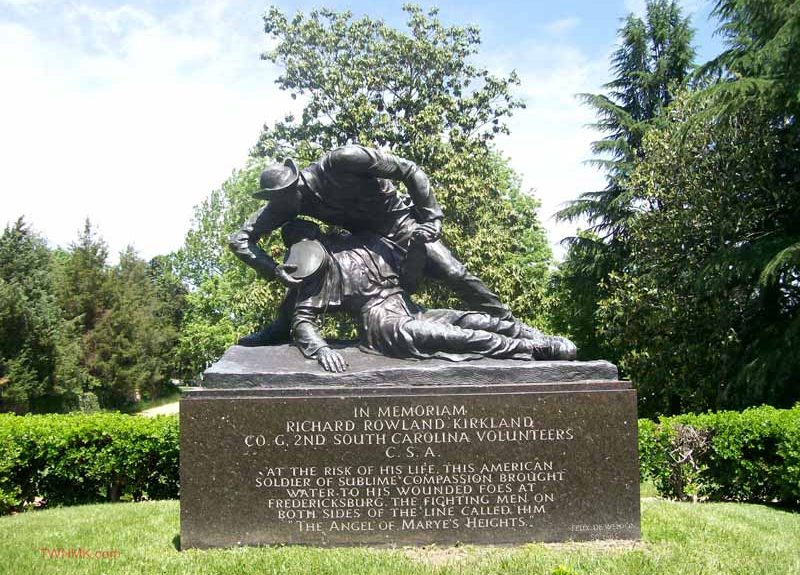
On the heights a South Carolinian, Richard Kirkland, was appalled by the cries of the wounded. He received permission to take water to the wounded. In broad daylight and without a flag of truce he gave water to the wounded. Federal soldiers held their fire since it was obvious what he was doing. He became known as the Angel of Marye’s Heights.
The following day the armies remained in position but little fighting occurred. Burnside asked for a truce to tend to his wounded, which Lee allowed. The Aurora Borealis was viewed that night, a rare appearance that far south. The following day Burnside retreated and pulled up the pontoon bridges.
The battle was a disaster for the Union. 12,500 casualties when compared to 5,400 Confederate. The North sank into despair but the South was jubilant. Burnside would remain in command for another month when he would make another attempt to get around Lee only for it to bog down in the mud in what became known as the Mud March. He would be relieved of command January 26 leaving an ill-equipped and ill-fed army with little fighting spirit. Conditions were so bad soldiers were coming down with scurvy.
Today the battlefield is part of Fredericksburg and Spotsylvania National Military Park. Some of the battlefield was been lost to modern development but much of it remains or at least is memorialized in town.