Major changes occurred following the Invasion of Kentucky. Don Carlos Buell was replaced by William Rosecrans and the army was renamed the Army of the Cumberland. While Braxton Bragg was retained of the Confederate side his army was merged with Edmund Smith’s army and took up the name Army of Tennessee.
Rosecrans army was in Nashville and his objective was eastern Tennessee. Rosecrans had won several smaller victories in Mississippi earlier but was warned that he would be replaced if he was passive. Bragg was in Murfreesboro taking up a defensive position along Stone’s River. He lost the troublesome Smith who was sent to take charge in eastern Tennessee and one of his best divisions was sent to Mississippi to help defend against U.S. Grant’s drive on Vicksburg. Bragg’s subordinates did not like him and petitioned Jefferson Davis to remove him and replace him with Joseph Johnston. Davis refused. Bragg would stay
Rosecrans, after a thorough retraining of the army and stocking of supplies, finally departed Nashville on December 26. His army had about 82,000 men but the force he took on campaign was much smaller as he had to maintain small garrisons all along his supply route. He had probably about 55,000 men with him in three different wings under Alexander McCook, Thomas Crittenden and George Thomas.
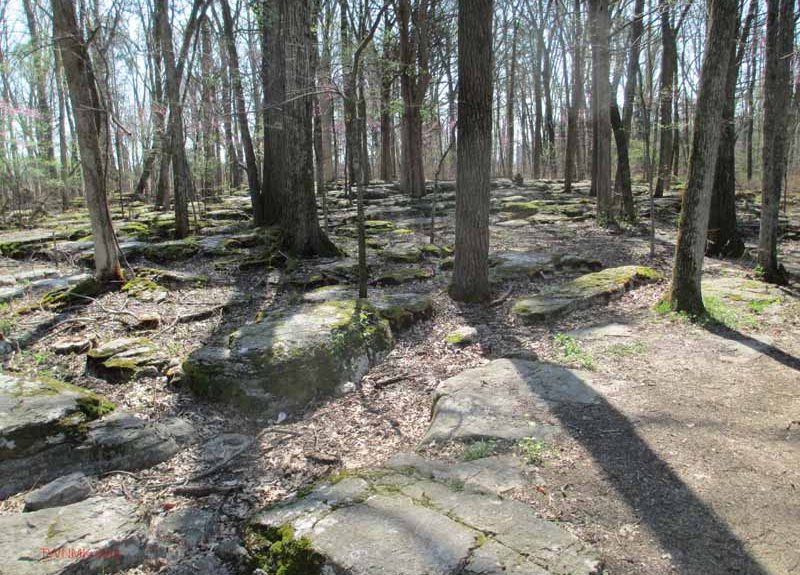
The area around Stone’s River was not the ideal place to fight a battle. There was no real significance to Murfreesboro or Stone’s River but Bragg was reluctant to give any more ground and kept his 35,000 men there. His force was divided into two corps, one under William Hardee and the other under Leonidas Polk. The area was flat but forested with some open fields. Limestone outcroppings littered the area and made travel with wheeled vehicles difficult. The major road in the area, the Nashville Pike was macadamized so it could handle the heavy army wagons.
Rosecrans’ army arrived near Murfreesboro on December 29. That day Confederate cavalry rode around his army capturing prisoners and destroying supply wagons. The inexperienced Union cavalry put up little fight. The following day both armies began getting into line. Both commanders wanted to take the offensive and hit the enemy’s right and get into their rear and cut the other side off from its base. Rosecrans ordered his men to be ready after breakfast. Bragg ordered his attack for dawn.
McCook, who was on the right, anticipated that Crittenden would make a major attack on the left. Crittenden would then wheel and Thomas in the center would join in. With little to do, McCook let his men build campfires and had them also build others to hopefully deceive Bragg as to where his flank was. The armies at this point were 700 yards away from each other and that night the two sides engaged in a war of music before both sides sang out Home Sweet Home.
At 6 AM Hardee hit first before the Union soldiers could finish their breakfast. 10,000 Confederates hit McCook’s hungry men. The dummy campfires did cause one division to drift to the right and open a gap but it was filled by the next Confederate division coming up. McCook’s men were swept aside and several of his artillery pieces were captured without being able to fire a shot. The Union troops were driven back three miles and Hardee was near the Nashville Pike by 10 AM.
Rosecrans canceled his attack and began moving Crittenden to the right. He had been slow in moving them believing that McCook could handle the attack but had changed his mind. Rosecrans himself tried to rally many of McCook’s men while covered in blood. A cannonball had taken off the head of his chief of staff who was riding next to him covering the commander in blood and brains.
Polk now moved to attack but the first foe he faced was ready. Phil Sheridan’s division was the first to be hit but Sheridan had anticipated action and had his men ready for battle at 4 AM and positioned in a forest. Three times he was assaulted and three times his men turned the Confederates back. Eventually Sheridan’s men would run out of ammunition and would be driven out of what became known as the Slaughter Pen. The cost to both sides was heavy though as Sheridan lost over one third of his division but had bought precious time.
Now things began to go badly for Bragg. Kentuckians under John Breckenridge had been left on the right to stop Crittenden. Unaware that Crittenden had moved off Breckenridge refused to send his men to support the attack. When Breckenridge did finally realize that the Union troops were gone Bragg received (false) intelligence that Union troops were coming down the Lebanon Turnpike to the south and canceled the order. Fresh troops could have made a difference but Bragg did not move them.
As Sheridan pulled back Hardee followed. Union troops rallied along the Nashville Pike and artillery was massed there. William Hazen’s brigade took position in the Round Forest overlooking a cotton field and blunted repeated Confederate attacks. The fighting here was so fierce it became known as Hell’s Half Acre. Rosecrans himself helped to lead some of the fighting. Along other parts of the line Rosecrans had to arm his Pioneer Corps to help with the fighting. He had a strong line that could be compacted if pushed back.
Bragg now called on Breckenridge at about 4 PM to cross Stone’s River and make a final assault but darkness came before it could happen. Despite not being able to land the killer blow Bragg was pleased and sent a telegram to Richmond announcing victory. That “victory” cost 9,000 of his men though. On the other side William Rosecrans held a council of war. Some of his generals wanted to retreat before they were cut off. Rosecrans along with Thomas and Crittenden opposed that and the decision was made to stay.
On January 1 Rosecrans moved some of his men to protect the river crossings on Stone’s River along with the artillery he had placed there. There was very little fighting this day as both sides rested and tended to their wounded while observing the New Year. In Rosecrans rear Wheeler’s cavalry was still on the loose and intercepted Union wounded on their way to Nashville. Wheeler interpreted this as preparation for a retreat and informed Bragg thusly.
Bragg was content for a retreat but yet Rosecrans was still there on January 2. Now was the time for Breckenridge and his fresh troops to attack. At 4 PM he pushed Union troops away from McFadden Ford and moved to attack the Union line. Instead his attack was blown apart by 45 Union cannon positioned hub-to-hub along a small open hill. A Union division counterattacked and Breckenridge fell back.
For the most part the fighting was over. Neither army left the field and Rosecrans became a bit more aggressive probing Bragg’s line. Bragg knew that Rosecrans would only get stronger as reinforcements were already arriving and not wanting to be caught by bad weather he ordered a retreat. Rosecrans made no attempt at pursuit.
This was not the largest or bloodiest battle of the war but it did have the highest percentage of casualties of any battle in the war. The Union lost 12,900 men and the Confederates 11,700. Bragg was scorned by his generals and only Jefferson Davis’ mistrust of Joseph Johnston prevented his removal from command though. Hardee was offered command but declined. For the Union this “victory” could not have come a t a better time. Lincoln had just issued his Emancipation Proclamation but the North was still in shock from Fredericksburg and Grant’s drive on Vicksburg had stalled. Nashville and Middle Tennessee were secure and at least something went right.
Much of the battlefield has been lost over time but some of it is preserved as part of Stone’s River National Battlefield. Hazen’s men erected a monument to their stand in 1863 and it is the nation’s oldest Civil War monument.