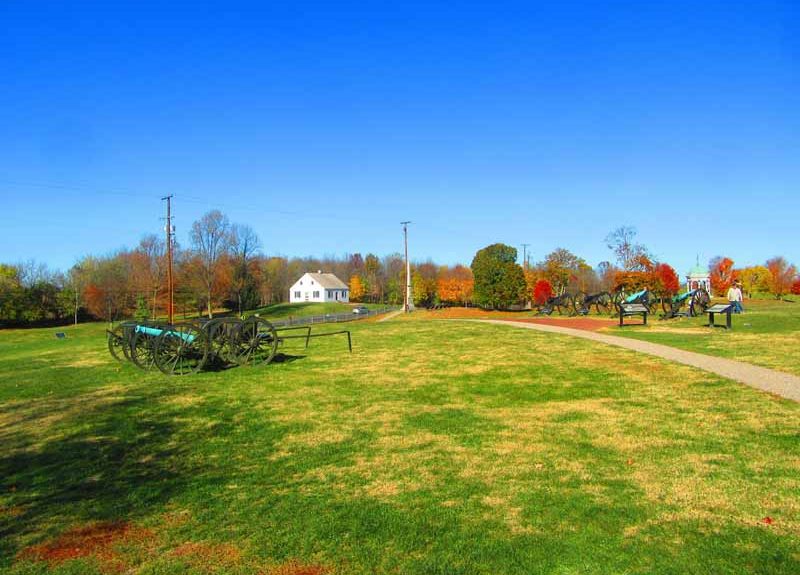
September 17, 1862 was the bloodiest day in American military history. George McClellan’s Union army and Robert E. Lee’s Confederate army clashed on the rolling fields and forests outside of Sharpsburg, Maryland. Lee had about 55,000 men and McClellan brought about 85,000 men to the field. Lee had been in the area since September 15 in a good but not great position but struggling to bring his divided forces together. He had not expected McClellan to cobble together a beaten army following Second Bull Run and move as quickly as he did, but McClellan had. The Antietam Creek posed a barrier but not one impossible to overcome as several bridges and fords allowed for passage. The local fields had numerous rock outcroppings which made great defensive positions. His problem was that the Potomac River was at his back and if he was cut off from it or needed to escape there would be problems.
On September 15 Lee only had about 18,000 men on the field. Stonewall Jackson was finishing his capture of Harper’s Ferry and would be on his way soon but George McClellan’s men were coming over the passes at South Mountain. Fortunately for Lee, the extremely cautious McClellan believed that Lee’s army was far more formidable and delayed attacking for a day. Union numbers continued to swell on September 16 as McClellan’s plan began to go into motion. Joseph Hooker and his I Corps was sent to the north across the Antietam Creek so that they could hit the Confederates in the morning from that direction. The opening shots of the battle occurred here as Hooker moved into position shortly before sunset.
Morning Phase
McClellan’s instructions to his commanders were not clear and he did not issue a general order about the battle plan. This would hamper his efforts the following day and very quickly at that. Hooker was ordered to begin his assault at dawn, about 5:30 AM. He was to take control of the plateau in front of him and he had about 8,600 men to do so. Stonewall Jackson, who’s men were defending had about 7,700. Union infantry emerged from the North Woods and into David Miller’s Cornfield and directly into the teeth of Jackson’s defense. Confederate artillery opened up as soon as they emerged. Union artillery responded in one of the fiercest artillery duels of the war when Hooker saw the glint of bayonets in the Cornfield and called for his artillery to clear it. The Cornfield now erupted into a maelstrom. More men on both sides were fed into the fight and eventually Federal numbers began to tell.
More Union troops advanced toward the West Woods but were stopped by a desperate Confederate charge. The Confederates were holding the ground but just barely. Reinforcements just arrived from Harper’s Ferry were fed in next and pushed the Union troops back through the Cornfield and West Woods. John Hood’s Division lost 60% of its men in this charge and when Hood was asked later where his division was he said it was “dead on the field.” Hooker’s men too paid a high price, he had lost 2,500 men and had gained no ground. Hooker called for support from the next corps in line, Joseph Mansfield’s XII Corps.
Mansfield’s initial attack made little headway but another punched a hole into Jackson’s line when George Greene’s division made it to the Dunker Church and drove off the Confederate batteries there. Hooker tried to get his men back into the fight but he was hit in the leg and taken from the field. With no support on the horizon the XII Corps men fell back.
Edwin Sumner’s II Corps was the next to enter the fray, arriving at 9:00 AM. John Sedgewick’s division was first to go in to assault the West Woods. They cleared the Cornfield but attacked in a long line. When they entered the West Woods they were hit from three sides and the division took 2,200 casualties in a matter of minutes. By 10 AM the fighting here was ending when Greene again attacked and seized some of the West Woods. After 13,000 combined casualties the morning phase of the battle was over.
Mid-day Phase
With the combatants to the north exhausted the fighting now began to shift further to the south. A sunken wagon road that was used to bypass a local toll booth was occupied by Confederate soldiers and became a strong defensive position. One division from Sumner’s corps became separated and by the time they were located Sedgewick’s division was in trouble. This division, under William French, was then ordered to assault to the south to create a diversion. Their assault went off at 9:30 AM with about 5,000 men. D.H. Hill’s Confederate Division controlled the Sunken Road with about 2,500 men. French launched a series of attacks that were all repulsed and lost around 1,700 men in about one hour. Reinforcements were on their way for both sides. Lee sent his last reserve, Richard Anderson’s Division to bolster the line with its 3,400 men.
Israel Richardson and his 4,000 man division was sent by Sumner. Richardson struck at 10:30 with the Irish Brigade leading the assault. They were repulsed and the next brigade went in around noon. This time they worked their way around the flanks and turned the Confederate position into a death trap. The Confederates pulled out with Richardson’s men in pursuit. A hastily assembled line under James Longstreet brought the pursuit to a halt and Longstreet himself manned a gun. One Confederate colonel, John Gordon, was wounded five times but refused to leave the field until a bullet went through his cheek and jaw and he nearly drowned in his own blood when he fell. He was only saved because the blood could drain out of a bullet hole in his hat.
Assaulting the Bloody Lane lasted from about 9:30 AM to 1 PM and cost the Union about 3,000 men. The Confederates lost about 2,600 men. If broken here the battle would be over and McClellan had ample reserves to do so but he chose not to. The Union soldiers were ordered to stay where they were. The fight would now move south.
Afternoon phase
Ambrose Burnside and his IX Corps was to have crossed the Antietam Creek earlier in the day but orders to do so did not reach him until 10 AM. Burnside and McClellan had been close friends until this campaign and Burnside was angry that his larger wing command had been terminated as battle approached. Burnside had 12,500 men at his disposal but he moved slowly to get his men ready.
Opposing him earlier were David Jones’ Division and John Walker’s Division but most of their men had moved north to fight in the West Woods and Cornfield. Only about 3,000 men were in position to stop Burnside with about 400 men under Robert Toombs defending the Rohrbach Bridge across the Antietam Creek.
A road led to the bridge with a bluff overtop of the Confederate side that provided an excellent position for Toombs’ men. A ford just to the south was available but unknown to Burnside until later in the battle. A ford had been identified but Burnside’s men found the banks too steep to be of any use so he would have to cross at the bridge.
Toombs’ men held off three attacks before the fourth simply rushed the bridge and after three hours to trying the bridge across the Antietam Creek was secure. It was no secret now that Burnside was coming and Lee moved every available man to stop him. Lee also knew that A.P. Hill’s Division would be on the field soon coming from Harper’s Ferry.
Burnside crossed his men slowly believing he would face only token resistance. He was to get around the Confederate army and cut it off from the Potomac with crossed 8,000 men and 22 cannon. Burnside began his assault around 3 PM and pushed nearly to the outskirts of town. Then A.P. Hill arrived. Hill counterattacked around 3:40 and Burnside’s men broke. Despite still maintaining a numerical advantage Burnside became unnerved and ordered his men back across the Antietam. He was more concerned with a counterattack from Lee at this point and spent the rest of the day guarding the bridge. Fighting ended at about 5:30 PM.
The losses were staggering. 12,400 Union casualties and 10,300 Confederate all in one day. Three senior US generals, Mansfield, Richardson and Isaac Rodman were dead and three Confederate generals were dead or would die of their wounds. McClellan remained at his headquarters well away from the battlefield for the duration believing that he was fighting the battle magnificently.
Following the battle both armies pulled back a bit. Lee did not leave put pulled back to the west behind Sharpsburg. He dared McClellan to attack but Little Mac chose not to. Lee eventually re-crossed the Potomac and slipped away. President Lincoln urged McClellan to pursue but no pursuit was forthcoming and the Union army remained in the area until October. Antietam though was declared a victory and it gave Lincoln the political capital to announce a preliminary version of the Emancipation Proclamation. With its defeat, the Confederacy had its hopes dashed for European intervention. Following the battle photographers descended on the battlefield and took some of the most iconic images of the war. These images stunned the public and brought the horrors of war to the home front. The battlefield today is well preserved with much of the land remaining as it was in 1862 as the Antietam National Battlefield.