John Bell Hood’s Confederate Army of Tennessee had one last chance to achieve victory and prolong the war in the western theater. Retaking Nashville, the capital of Tennessee, would be a huge feather in his cap and would hopefully draw thousands of new recruits and deserters back to his ranks but taking the city would not be easy. George Thomas had 55,000 Union soldiers guarding the city and most of them were combat veterans. Nashville had been in Union hands since 1862 and was well fortified.
Thomas’ force was a mix of other armies. Thomas Wood commanded the IV Corps from Thomas’ old Army of the Cumberland. John Schofield commanded the XXIII Corps from the old Army of the Ohio. A.J. Smith, recently arrived from the failed Red River Campaign, commanded the Detachment of the Army of the Tennessee. The District of the Etowah, made up mostly of green and garrison units, was commanded by James Steedman. Thomas’ cavalry was led by James Wilson.
Seven miles of defensive works ringed the city with the largest being Fort Negley just south of the city. The Cumberland River formed a defensive barrier to the east of the city and following the Battle of Franklin the works were extended west.
Hood arrived from the south on December 2. He had about 30,000 soldiers and knew that Thomas’ force was much stronger. His men began constructing fortifications in the hope that Thomas would attack which would give the defenders the advantage. Hood also sent five brigades of infantry and Nathan Bedford Forrest’s cavalry south towards Murfreesboro as a diversion to try to draw Thomas out and defeat him in detail. Thomas did not take the bait and the garrison at Murfreesboro drove the Confederates off.
Thomas was a cautious fellow. He would not be rushed into a movement but when he got started he was a courageous fighter. His stand at Chickamauga had saved the army and garnered him with widespread fame throughout the North. He was also a native Virginian who had stayed loyal and had been disowned by his family.
Thomas did not want to move until his cavalry was refitted. Thomas’ superior William T. Sherman did not care what Hood did but he had disappeared into Georgia. U.S. Grant, the general-in-chief, did care what Hood did and the last thing he wanted to see was a Confederate army on the banks of the Ohio River. With the end of the war seemingly in sight any negative press, especially in the wintertime when nothing else was going on, would be a tough pill to swallow by the Northern populace. Pressure from Washington was coming down hard on Thomas to act but he had other things to worry about. An ice storm hit on December 8 and freezing weather continued for five days. No offensive actions could be made. Despite this being explained to Grant, he was losing patience and sent John Logan to take command on December 13. It would take time for Logan to arrive and if Thomas had not begun moving Logan was to assume command. Grant himself left Petersburg the following day to travel to Nashville to take command personally.
The Confederates had blockaded the Cumberland River and had briefly captured several Federal transports. A Union ironclad and a tinclad were able to recapture the supply of horses, mules and fodder. Federal cavalry drove the Confederates off on December 15 reopening the Cumberland. Now it was time to strike.
Thomas planned to launch a diversionary attack on his left and hit hard on the right. Steedman’s inexperienced troops would provide the diversion and Thomas’ veterans would be the fist. Steedman’s attack was initially successful overrunning the skirmish line but it was hit hard by Hood’s artillery and forced back. The overall goal failed as no Confederate troops were moved from the Confederate left to reinforce the right.
On the Confederate left the morning was foggy. Smith, Schofield and Wilson overran 4 Confederate redoubts, some easier than others. Wood launched a frontal assault down the Granny Smith Pike and proceeded up Montgomery Hill and overran the skirmish line. They linked up with Smith and seized the last Confederate redoubt. Only an effective rearguard action by Stephen Lee’s Corps prevented a rout.
Hood pulled back to a stronger and more compact line running from Peach Orchard Hill to Shy’s Hill. The center had a long stone wall. Lee’s Corps was placed on the right as it was Hood’s most intact and strongest corps. It had not seen much action yet and had mostly missed Franklin. A.P. Stewart’s Corps, which was a shell of its former self, was in the center. Benjamin Cheatham’s Corps was on the left and at Shy’s Hill.
Shy’s Hill looked formidable but on the crest the line formed a salient which was pounded by Thomas’ artillery. The trenches were dug by exhausted and hungry troops and were placed on the geographical crest rather than the military crest. The slope was so steep that attacking troops would be sheltered from enemy fire until they were all but on to of the enemy. It was a recipe for disaster.
On December 16 Thomas’ plan was unchanged. He would hit the Confederates with a big right hook. A diversion on the left would hopefully draw troops away from the center and right and then Schofield would deliver the knockout blow. At 3 PM the assault began with two brigades from Wood and Steedman assaulting Peach Orchard Hill. This time the attack made significant gains and drew troops away from the other end of the line. Wilson’s cavalry was also stretching Cheatham’s Corps to the breaking point.
Schofield for whatever reason wanted more men to attack so Smith was ordered to send some of his men but still Schofield did not move. This was too much for John McArthur, one of Schofield’s division commanders. He sent a message stating that unless he heard otherwise he would begin the attack. McArthur saw how thin the Confederate line was situated and did not want to waste the opportunity. When no response came he attacked and caused Hood’s left to disintegrate while the Union began to roll up the rest of the line.
Hood’s men fled south. Lee’s Corps once again provided a rear guard defense but there was no third line to fall back to. Wilson pursued but Thomas was slowed. He had sent his pontoon bridge train toward Murfreesboro rather than Franklin where the Confederates were heading but Wilson pursued until Columbia where he turned back due to lack of supplies and the arrival of Forrest. Thomas pursued slowly with the rest of the army, crossing the Duck River a week after the battle ended. Forrest slowed his pursuit and allowed Hood to get across the Tennessee River to safety. Steedman’s men were sent by rail to Chattanooga and then by boat to Decatur, Alabama where they managed to seize a good portion of Hood’s supply wagons.
Hood’s army was ruined. He had lost somewhere around 7,000 men and his once proud army numbered about 18,000 men as the New Year turned. Hood’s career was ruined and in typical Army of Tennessee fashion he of course blamed everyone else. Thomas lost about 3,000 men. Legend has it that Grant made it to Washington DC and was writing out the order relieving Thomas of command when he was told that Thomas had won a great victory. He then proceeded to tear up the order.
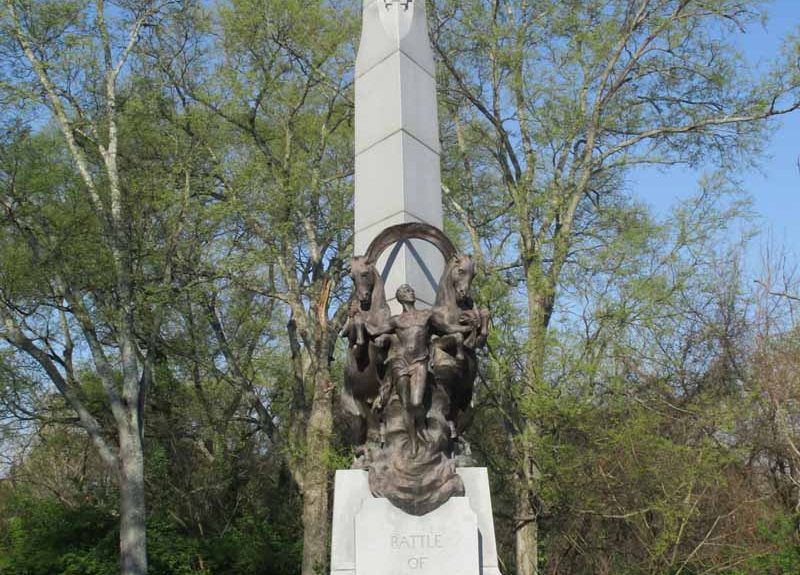
In the early 20th century a National Battlefield was considered for the Nashville area but the civic leaders were not interested. Much of the battlefield has since been lost to development and only a handful of it has been preserved. The remains of Fort Negley still exist as does Shy’s Hill. A monument was erected in 1927 and was damaged by a tornado in 1974 before being moved to accommodate the construction of the I-65/440 Interchange. It was moved to the Granny White Pike. A handful of monuments were erected in the National Cemetery. Unfortunately for me when i visited in 2014 I did not look hard enough as to what was there and missed several of the sites. I’ll have to go back.