In November 1864 William T. Sherman was only too happy to let John Bell Hood and his Army of Tennessee disengage and move north. Sherman wanted to march on Savannah and had finally been given permission. He took 60,000 men with him and left the rest of his army under the command of George Thomas who was ordered north to Nashville to defend the city from Hood with about 60,000 men.
Hood and his 39,000 men entered Tennessee with the goal of defeating Thomas’ larger force in detail before it could concentrate. After doing so he would continue north into Kentucky with the hope of making it to the Ohio River. Hood envisioned gaining 20,000 recruits to strengthen his army and then moving to aid Robert E. Lee in the spring. He began heading north on November 21 and moved fast and caught the Union offguard. John Schofield, in command of David Stanley’s IV Corps as well as his own XXIII Corps began moving north toward the Duck River and Columbia, Tennessee. He had about 27,000 men and was trying to reach Nashville before Hood.
Schofield reached Columbia first and blocked Hood for five days. On November 29 Thomas directed Schofield to continue falling back toward Franklin. Thomas was expecting reinforcements and wanted to bring all of his forces together before fighting. Hood would have sent him north on his way anyway as he crossed the river east of Columbia and would have threatened Schofield’s flank. Things were getting worse for Schofield who was in trouble as his army was spread out on the road and split. Some of Stanley’s men were at Spring Hill but the rest were on the march. Hood reached Spring Hill before nightfall and planned to trap Schofield but his senior officers did not perform and Schofield’s army slipped by with not even a shot being fired even though the two armies were only a hundred yards away or so. A golden opportunity was wasted.
By dawn on November 30 Schofield deployed his men south of Franklin on a high, open ridge. The Harpeth River in town was high and his army would not be able to cross it as he had no pontoon bridges. He had been forced to leave his pontoon train behind in Columbia and the bridges he requested from Thomas had not arrived yet so he set about to defend Franklin. By noon his defensive works were ready. Hood was furious when he found out that Schofield had eluded him and blamed his generals but what was done was done. Hood’s march north continued.
Schofield’s line formed a semi-circle around the town centered along the plantation belonging to Fountain Carter along the Columbia Pike. A small gap along the pike was left open to allow for wagons to pass through but a small defensive work was just behind the gap. About a half mile forward of the line was another small entrenchment that held two brigades that were the last to arrive in George Wagner’s division. Wagner believed that he was ordered to hold the position he occupied misinterpreting orders that he had been issued earlier. One of Wagner’s brigade commanders, Emerson Opdycke, refused to put his men in the works and continued on to the main line.
Schofield planned to cross the Harpeth at 6 PM if Hood did not press the issue. Hood’s men came on scene but Schofield expected him to try to turn his flank as he had done before. He did not think Hood would launch an assault on his works with the daylight running out but Hood ordered an assault anyway. Hood stated that he would rather fight a force that had only a few hours to erect defenses rather than the force at Nashville which had been building defenses for years. Hood also believed that trying to flank Schofield would take too long and he would slip away overnight.
None of Hood’s subordinates wanted to attack but the order was given and the attack moved forward at 4 PM with about 30 minutes of daylight remaining. Hood’s attack would not be with his whole army as Stephen Lee’s Corps along with most of the artillery was still en route. and Nathan Bedford Forrest’s cavalry was positioned to cover the fords. Hood’s attack quickly enveloped Wagner’s two isolated brigades which valiantly attempted to stand their ground but were soon routed. Wagner had nearly 700 of his men captured and he would be relieved of command following the battle.
Hood’s men followed Wagner’s as they attempted to get into the works with them. Schofield’s defenders held their fire to avoid hitting their comrades. Near the Carter House the Confederates broke through and opened a 50 yard wide breach in the line. Opdycke’s men were now the only resistance between Hood and Franklin and he ordered his men forward. His attack was joined by other Union troops and the breach was sealed with hand-to-hand fighting. Fighting took place all across the line sometimes with the combatants on the opposite side of the trenches from the other. The Union’s advantage in position and firepower with repeating rifles began to tell.
Fighting continued after dark. Hood attempted to throw Edward Johnson’s Division, which had just arrived on the field, into the battle but Johnson got lost in the darkness and was delayed. They made one assault which was repulsed with heavy losses and Johnson’s men were ordered not to fire as many of their comrades were pinned down outside of the Federal works.
It was a bad day all around for the Confederates. Forrest moved some of his men across the Harpeth to turn the Union left. Two divisions were moved forward and were countered by Union cavalry armed with repeating carbines but with fewer numbers. Forrest’s men were defeated in combat by a smaller force for the first time in the war.
With darkness set in no more assaults would be ordered. Hood planned to continue in the morning but Schofield received orders from Thomas to pull back to Nashville and began the movement at 11 PM. Hood did not take advantage and began a pursuit the following day so Schofield beat him to Nashville easily.
Franklin was a disaster, often called the “Pickett’s Charge of the West”. Hood lost about 6,300 men including 6 generals killed and 6 generals wounded and one captured. One of the dead soldiers was Tod Carter, who died in his family’s home. Schofield lost about 2,300 men, mostly from Wagner’s division, and left his wounded behind.
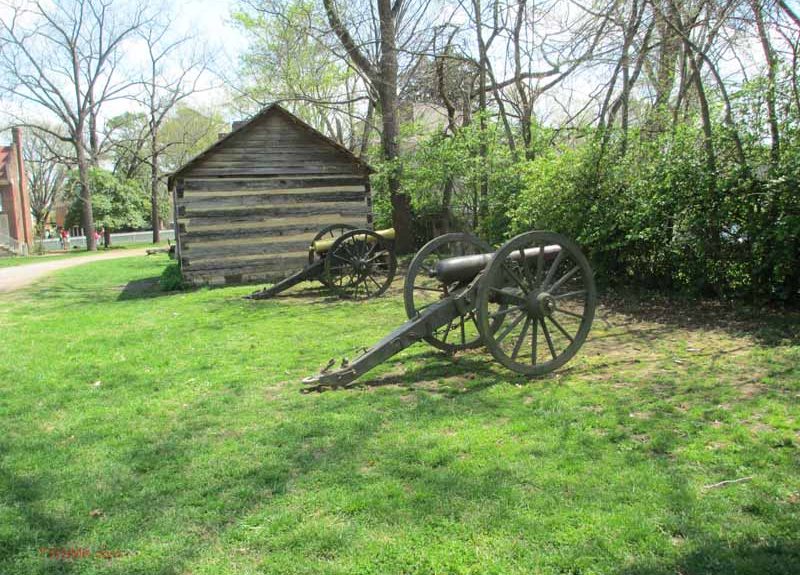
Little of the battlefield remains today. The Carter House is open as a museum as well as the Carnton Plantaion. A small park is on Spring Hill. Since I visited in 2014 the Civil War Trust had been active in acquiring properties and razing them along the battlefield near the Columbia Pike. It will be interesting to return and see what has been done.