The US has had ambitions to take Canada from the moments when war began in 1775. At first we wanted to “liberate” them but found they did not want to be liberated. When the War of 1812 came around the US was looking to expand its territory. A plan was hatched to invade Canada and became known as the St. Lawrence Campaign. It was planned by the Secretary of War, John Armstrong, who envisioned himself leading it.
No one was really sure what the objective was. It could be Montreal or it could be Kingston, the Royal Navy’s base on Lake Ontario. The US Navy’s commander on the lake did not want to risk his ships so Kingston and the strong Fort Henry was probably ruled out. The army’s commander, James Wilkinson, didn’t have the trust of his officers. Training was poor and disease ran rampant and this should never have been attempted.
The first Americans under Wade Hampton moved out on September 19 following the River Richelieu from Lake Champlain. He had 4,000 men but had to wait for Wilkinson and John Boyd, who was coming from the recently captured Fort George. Armstrong at this point still wanted to command but changed his mind when he arrived at Sackett’s Harbor and returned to Washington placing Wilkinson in command. Hampton, operating under the original set of orders attacked Chateauguay and was repulsed. Following the defeat he resigned immediately.
Wilkinson used boats to transport his army but on November 1 they came under fire from the Royal Navy. Wilkinson’s artillery was able to drive them off and he proceeded down the St. Lawrence River eventually landing men in Canada on November 8. He learned that the British were pursuing him and he landed his rear guard under Boyd nearby. The British, under Joseph Morrison caught up with them on November 10 near Chrysler’s Farm.
The farm presented open fields with muddy ground surrounded by woods. The British had all of the advantages as the superior American force would not be able to maneuver. Fighting broke out the next day in a cold rain and both sides believed that the other was attacking. Boyd had around 2,500 US regulars while Morrison had about 900 men. An assault was ordered in the mid-afternoon and pushed British skirmishers back but they were startled to see Redcoats and the assault ground to a halt and eventually retreated. Boyd began to lose control of the battle and the American line began to crumble. Only a charge by US dragoons allowed for the artillery to be taken off of the field and the American army was in retreat by 4:30 PM.
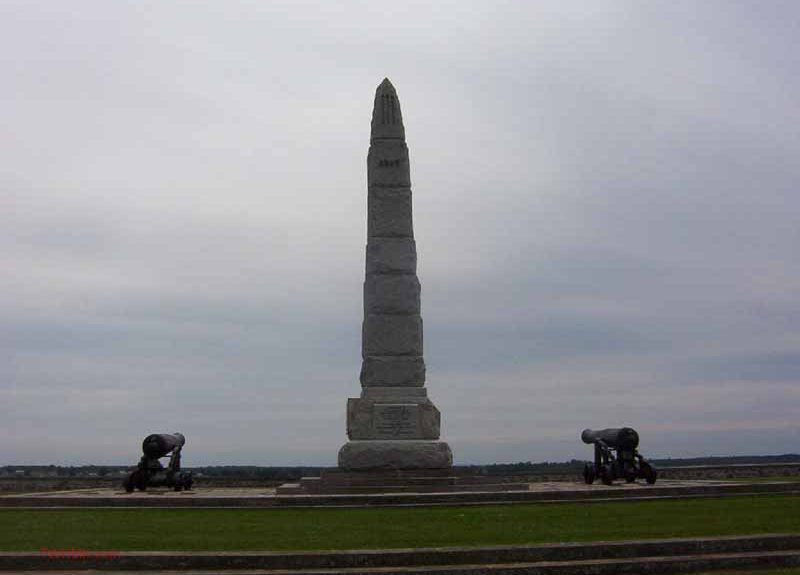
The Battle cost about 180 British casualties and about 450 Americans and the campaign began to unravel from there. Combined with Hampton’s defeat at Chateauguay Montreal was never threatened and the American army eventually retreated out of Canada. I visited here almost by accident. While on a bus trip to see Ontario and Quebec we stopped at the adjacent Upper Canada Village. While it was nice to see that attraction a large monument caught my eye and I went over to check it out and this is what was there. Sometimes you just luck out. It was the Chrysler’s Farm Battlefield and has a small museum.