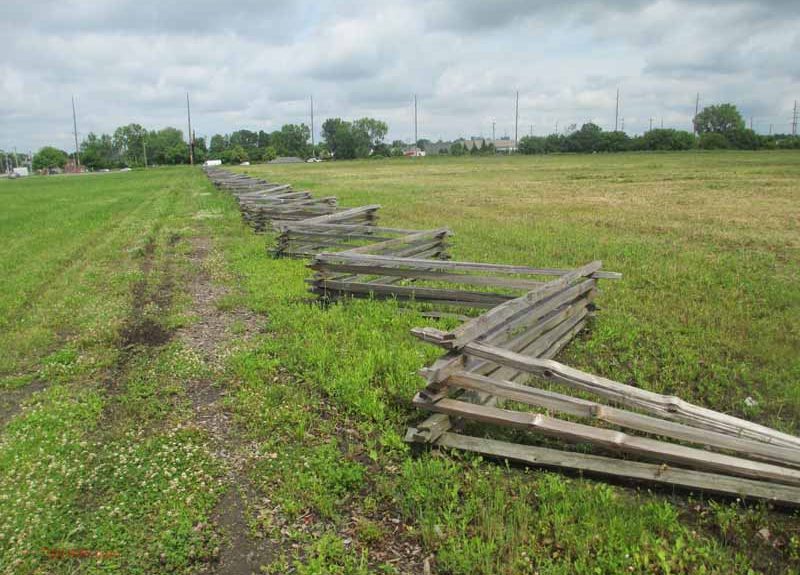
Two different battles were fought here in January of 1813. The American army at Detroit had been forced to surrender in 1812 and this convinced many Native Americans to side with the British during the conflict. When Detroit fell the Frenchtown Militia had been disarmed and with Frenchtown being the only major settlement between Detroit and Ohio it had to be held to prevent an invasion of Ohio.
James Winchester was placed in command with orders to retake Detroit but he had other ideas which placed him at odds quickly with the Madison administration. William Henry Harrison was sent to take charge, with Winchester being retained as the second-in-command. To the north the British were marshaling their forces in Detroit with about 500 Native Americans to push south.
Winchester was given command of one of Harrison’s columns and was ordered to stay close to Harrison. He immediately disobeyed his orders and sent Colonel William Lewis into Michigan along the shore of the frozen Lake Erie with about 750 men, mostly Kentucky militiamen. He crossed the River Raisin and attacked Frenchtown, which was defended by about 250 British and Native allies. After a heated battle the Americans controlled Frenchtown again. Lewis lost about 70 men and the British lost about 20.
Winchester now moved his men to Frenchtown and Harrison could do nothing more than reinforce him sending him a few companies of US regulars and orders to hold the town. He did not bring more ammunition forward nor did he strengthen the defenses of the town and he also ignored warnings that the British were coming back.
The British commander in Detroit, Henry Proctor, did not want to lose Frenchtown and left Detroit with about 1,400 men to reclaim it. On January 22 he surprised Winchester before sunrise. The Regulars stood for about 20 minutes before running. and the retreat turned into a rout and eventually into a bloodbath. Natives killed the retreating soldiers, scalping many of them. Most of the force, including Winchester, was captured or killed. Winchester was stripped of his uniform and turned over to the British. Only a handful of Americans got away, mostly by removing their shoes and running in their socks which left imprints like moccasins in the snow.
Not all defenders had left Frenchtown. The Kentucky Militia held its ground and had managed to pick off many of the British cannoneers but they were running out of ammunition. The captured Winchester was told to make them surrender and a note from Winchester was sent to them. The Kentuckians did not trust the Natives and decided to fight to the death rather than take their chances. Fighting resumed for another three hours and when ammunition was depleted they surrendered.
Proctor was worried that Harrison was coming so he beat a hasty retreat. The Natives refused to burn Frenchtown as they had given the land to settlers and did not want any more trouble than they already had. Proctor marched his prisoners, about 500 of them, towards Detroit. Those who were too injured and left behind or fell behind during the march were killed by Natives. This, along with the killing of the retreating soldiers, became known as the River Raisin Massacre.
About 300 American were killed at Frenchtown and with the killing of surrendering men or wounded men it incensed the American public. The British had taken about 200 casualties in the second battle but American blood was up. Kentucky lost many of its leading citizens and the defeat only prompted more to enlist. Frenchtown was retaken in September as was Detroit and the British were pushed back into Upper Canada following their defeat at the River Thames. “Remember the Raisin” became the battle cry of the American army.
In Kentucky today nine counties are named for Kentuckians who fought at the Raisin. The battlefield, or what is left of it is preserved as one of the newest units of the National Park Service as the River Raisin National Battlefield.