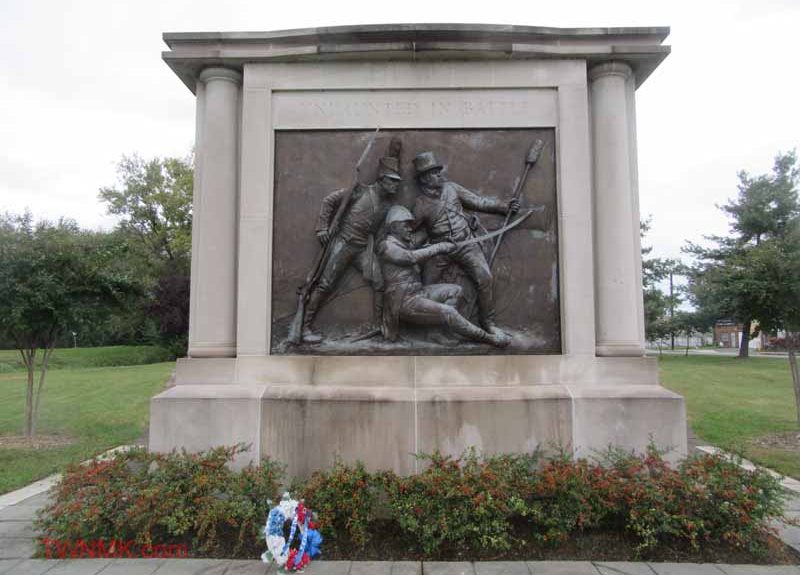
The Battle of Bladensburg is one of the worst defeats of the American army in our nation’s history. It is no surprise that there is very little of the battlefield remaining as this is a defeat that we would like to forget and that is a big problem that I have with our modern study of history. If something is not a part of the public knowledge then it most assuredly did not happen and we can all forget about it, especially if it embarrass us. But our army in its early days was not the juggernaut that it became in the 20th century and there were embarrassments in there along the way and Bladensburg may be the worst of them.
For the most part early in the War of 1812 Britain was occupied with defeating Napoleon, a much more pressing matter then us upstart Americans. After Napoleon was defeated and exiled they could turn their attention on us. By 1814 the British had taken control of the Chesapeake Bay, inhibited trade and occupied several islands with soldiers. Thousands of veteran soldiers were on their way commanded by Robert Ross.
President James Madison met with his cabinet to create a plan. Secretary of War John Armstrong did not believe that the British would target Washington instead targeting Baltimore, a major commercial center. Madison placed the recently captured and exchanged John Winder in command of the 10th Military District. Winder was named unbeknownst to Armstrong, who would provide no support to him though Winder did little to help his situation as he ordered no fortifications to be built though he wanted to call up the militia. Armstrong did not want to call up the militia just yet and his view won out.
The Royal Navy favored a quick strike on Washington but Ross was not as enthusiastic. His men had spent the last three months on ships and he lacked cavalry and he also feared the American’s Chesapeake Bay Flotilla which could do major damage to a landing. The Royal Navy decided to launch diversionary attacks to keep the Americans otherwise occupied and landed Ross’ men on August 19 near Benedict, Maryland. The Royal Navy proved to be too powerful and the Chesapeake Bay Flotilla were forced to destroy their ships or retreat to Washington. Ross began marching towards DC on August 20.
Ross reached Upper Marlboro where he had the option of moving on Baltimore or DC which confused the American leadership. If Ross had proceeded he might have marched into Washington unopposed but he decided to rest his men. The hot August weather was not quite what they were used to. On August 23 he decided to attack Washington with a force of British soldiers and liberated slaves totalling about 4,400 men. He had two routes to choose from, a more northerly route from Woodyard or a more easterly route near Bladensburg. The easterly route was quicker but if the bridge over the East Branch of the Potomac River (the modern Anacostia River) was destroyed he would have to change. Ross gambled and took the easterly route.
Winder now called up the militia. He had about 15,000 militia men at his potential disposal but by the time of the British attack had only about 1,500 with about 400 regular US army soldiers. His small army had clashed with the British near Woodyard and had been forced to retreat believing that Ross would make a night attack (a common tactic during the Revolution). Winder had one major advantage, he had more cannon but he believed that this would not matter. He ordered a brigade of the Maryland Miltia to moved from Baltimore to Bladensburg and they took up position on August 22 at a road junction controlling the roads to Baltimore, Annapolis and Washington.
After the fighting at Woodyard Winder intended to destroy the bridge at Bladensburg but the militia commander there, Tobias Stansberry, began to fear for the safety of his position. He pulled his men back across the Potomac (Anacostia) River and did not destroy the bridge, taking a new position 1.5 miles away and throwing away every potential tactical advantage that the Americans would have had. At the same time government clerks were evacuating Washington with any paperwork or anything of value that could be moved.
By the time Winder arrived he had about 7,000 militia men at his disposal as well as about 1,000 US regulars and marines. Stansberry had constructed earthworks and placed artillery but it was not as strong as a position as he had given up and the earthworks were designed for heavier artillery then Stansberry had. There was little co-ordination between Stansberry and the other militia commanders and each deployed as they saw fit. Madison himself came out to inspect the defenses with his minions meddling in the disposition of the soldiers. The soldiers were exhausted from 2 days of constant marching, counter-marching and standing under arms.
Ross arrived on August 24 and took advantage of Stansberry’s poor decisions. He crossed the Potomac relatively unopposed and began his assault. Ross quickly forced advanced elements of the American army back and pressed on but now the British assault bogged down as they made three assaults and each were repulsed. Eventually Ross began to overlap Winder’s left flank and Winder ordered a retreat. Some of the Maryland Miltia under Samuel Smith retreated in orderly fashion but the order to retreat did not reach much of the rest of the line which descended into chaos. There was a brief stand by men under Joshua Barney’s naval flotilla force (which included African-American defenders) but they too were driven from the field when Barney was wounded. Most of the Maryland Militia present simply deserted during the retreat and returned home.
The Americans were routed from the field outside of the capital. Ross lost about 250 men, many of them to heat exhaustion and not American bullets while Winder lost around 150 but also 10 cannon. The American forced fled the field as quickly as they could in what became known as the Bladensburg Races. Madison had been present for the battle and had even taken command of a battery of artillery in the only instance in American history where a sitting president commanded troops in the field. When the rout ensued Madison was nearly captured. Ross’ men entered Washington that night and proceeded to burn government buildings in the city. The Executive Mansion was burned and when rebuilt was given a nice white coat and a new name.
Ross would set his sights now on Baltimore where he would have a much tougher assignment. Winder was court-martialed (and later acquitted) and replaced by Smith to command the defenses of Baltimore. Winder was placed in command of troops southwest of Baltimore (at modern day Patterson Park) which would have been the site of the main attack of the British had they attempted it in fortifications planned and built by Smith. He could have redeemed himself but never got the opportunity as Ross declined to attack. His largest legacy was his son, who would be a Confederate general who was in charge of the prison system with his headquarters at Andersonville. His son luckily died before the end of the war and avoided the fate of Henry Wirz, or perhaps Wirz paid for his son’s decisions.
Very little of the battlefield remains today. A monument was erected in commemoration of the battle and a short walking trail takes visitors along the path of some of the fighting. Like much of suburban Washington modern development was destroyed what is left of the battlefield. It is perhaps our worst military loss and it seems many just simply want to forget that it ever happened. It’s a bit hard though…