War makes people do horrible things to each other and the Civil War was no different. Being a prisoner of war was not an experience that anyone wanted to endure and the most notorious prisoner of war camp was Camp Sumter in Andersonville, Georgia more commonly referred to as simply Andersonville.
Andersonville was selected due to its isolation away from the fighting and its nearby railroad depot. The cartel that governed the exchange of prisoners broke down when the Union government insisted that black soldiers were to be treated the same as white soldiers and exchanged the same way. The South had made known that they would return or sell into slavery any black soldier caught in Federal uniform. Thus the exchange of prisoners came to an end. While seemingly heartless this would benefit the North as their greater pool of manpower would become more of an advantage.
Since the South would be taking in prisoners multiple sites were needed. Camp Sumter was laid out in February 1864 and the first prisoners arrived before the stockade was even finished. Members of the Georgia State Guard, old men and young boys mostly, were assigned to guard duty. Two entrances in the north and south wall provided access to the pen with a small swampy creek called the Stockade Branch providing water. The upper part was dammed so that prisoners could bathe and draw fresh water and the prisoners were to use the run off as their toilet. Suffice it to say the prison stank and became a haven of disease.
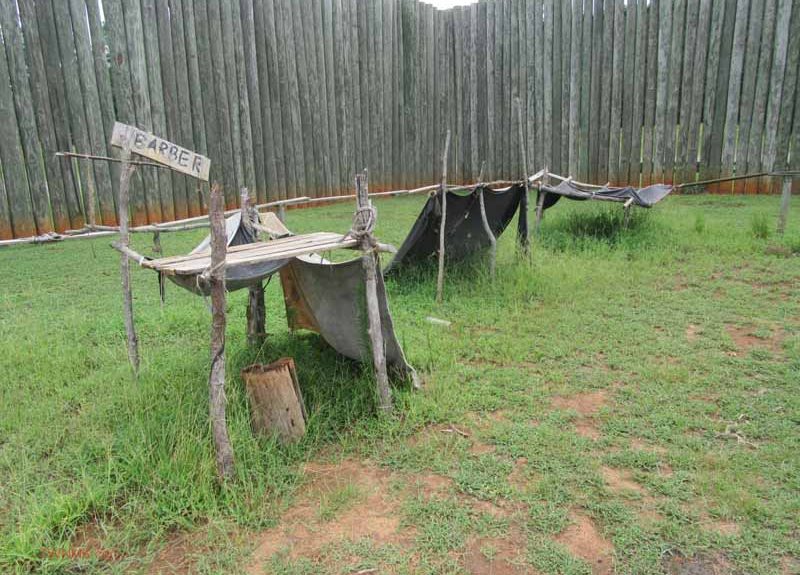
The prison was enlarged in June of 1864 to accommodate the growing number of prisoners. Commandant Henry Wirz was reluctant to accept new prisoners as he knew the pen was already overcrowding but his superior, John Winder, whose headquarters was also at Andersonville, continued to bring them in. The conditions in the camp were horrible. Most prisoners dug into the ground for living quarters to escape the Georgia heat and covered the entrance with what little cloth they had in what was known as a shebang. Few escapes resulted from these holes as the clay soil was not stable enough to dig through. Food rations were scarce, though the prisoners went without food on only a handful of days. In the morning the entire prison would assemble in their respective companies to be counted, a process that took the entire morning. They would then be issued rations, mostly salt pork and sweet potatoes, from the corrupt prison quartermaster. The Georgia State Guard also received the same rations and suffered from the same ailments.
The health of the prisoners deteriorated as scurvy and dysentery killed a large number of men, men who would have been able to live by just being able to eat an onion or apple every so often. Prisoners became skeletons. Thousands became sick from drinking from the creek and dysentery ran rampant. For those who made it into the prison infirmary there was little chance of return and the prison cemetery was continuously being enlarged. At its peak 100 men died a day. It could have been worse but during a thunderstorm a piece of ground just outside of the pen was struck by lightning and fresh water bubbled up from the ground. Wirz allowed for this spring, called the Providence Spring, to be channeled into the stockade to provide fresh drinking water. If this hadn’t happened it is certain that more prisoners would have died.
The prison was surrounded by wood and Wirz did send out work parties to cut down wood on the promise that the workers would not try to escape. Many broke that promise and the work parties came to a halt. Most escapees were hunted down and few ever tried to escape through tunnels as the ground was not suitable for tunneling. A few men did escape and reached Sherman’s lines and the stories told brought Sherman’s wrath down on Georgia during the March to the Sea but did little to help their comrade’s plight as Sherman was moving away from them.
The prisoners survived by forming their own social groups and providing for each other. They would nurse a sick man rather than sending them to the infirmary but their task was not helped by groups of prisoners that stole and murdered others, or what became known as the Raiders. Eventually the prisoners had enough and fought back forming another group called the Regulators which subdued the Raiders. Wirz allowed the prisoners to be tried and when found guilty executed by hanging.
Conditions were so bad that in July of 1864 Wirz paroled five prisoners to go to Washington and plead for the resumption of the prisoner exchange. The request was denied and the Union soldiers, who had pledged to return as condition for their release, did return. In the fall of 1864 some prisoners were to be transferred to relieve the overcrowding to Camp Millen near Milledgeville. Unfortunately for them when Sherman’s men, who were incensed by the stories of Andersonville told by the escapees, found Camp Millen they destroyed the place. The prisoners, who were on their way returned to Andersonville.
At its peak Andersonville held about 32,000 prisoners and about 45,000 overall. 13,000 men walked into the gates and never left. A prisoner copied the ledger of the dead believing that the master list would be destroyed when the war ended. He carried that list out of Andersonville and it was used against Wirz later. The prison was emptied when the war ended in May 1865.
Wirz was arrested and tried for war crimes. Ex-prisoners testified to his cruelty and barbarity and evidence that he was either incapable of doing what he was said to do or was not even present was ignored. He was railroaded since the public’s blood was up and he was the only Confederate official to be tried and executed for war crimes. Winder, who was in charge of the overall camp and all Confederate prisons, died in February of 1865 and could not be tried.
Today Andersonville is preserved as a part of Andersonville National Historic Site. The American prisoner of War Museum is also on site. Parts of the stockade have been reconstructed.