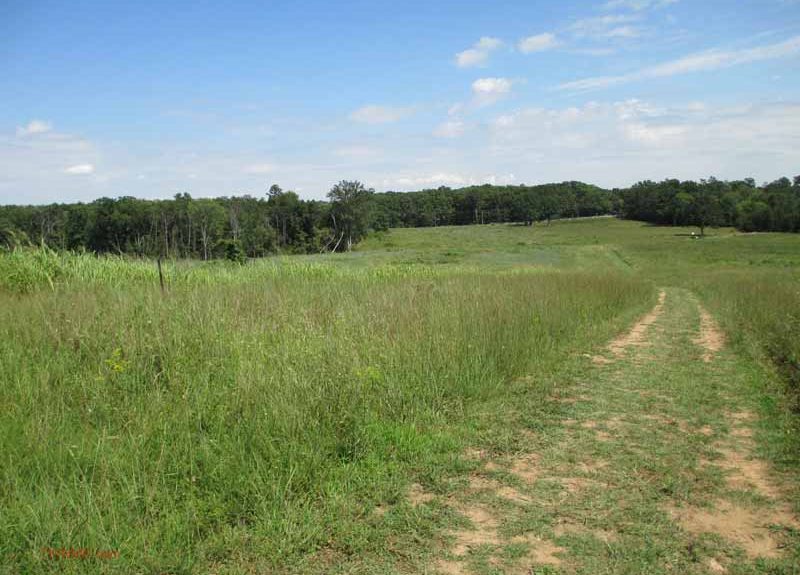
On August 29 Pope moved about 20,000 men into position to assault Jackson along the Stony Ridge. Jackson saw the buildup and sent A.P. Hill to the left to secure his flank. This ground was unsuitable for artillery and it was heavily wooded. Richard Ewell’s Division held most of the rest of the line.
Pope was beginning to receive reinforcements from McClellan with Fitz-John Porter’s V Corps. Porter and McClellan were friends and Porter resented Pope. He did not want to see him achieve any glory when McClellan couldn’t. Porter was ordered to attack what Pope thought was Jackson’s right when he arrived on the field. Franz Sigel, who was on the field, would attack Jackson’s left. Attacks began at 7 AM. The assaults made little headway as they were uncoordinated and lacked punch. As a result Jackson’s men, protected by the unfinished railroad embankment, pushed them back easily.
Another assault at 10 AM failed. Supporting forces failed to engage and just simply fell back. Pope’s plan was failing and he was not yet present to control events (not that it would have helped). He arrived on the field at 1 PM expecting to see the culmination of the battle but instead found his attacks had been pushed back. More reinforcements from McClellan were arriving but Pope assumed that McClellan would be arriving shortly with the rest of his army and he considered stopping the fight and falling back but worried about the fallout.
Now Pope got some good news, his other corps under Irvin McDowell was nearing the field. But there was bad news as well, Longstreet’s men were beginning to arrive. Pope now sent a message to both Porter and McDowell to tell them what to do. The orders were unclear and contradictory and there was no actual direction in the message. Pope wanted them to move and attack Jackson’s right but they were nowhere near there.
By mid-afternoon Lee arrived on the field. He wanted Longstreet to make an immediate assault on Pope but Longstreet observed Federal troops south of the Warrenton Turnpike that overlapped his line. Longstreet wanted to wait and Lee relented when his cavalry chief J.E.B. Stuart told him that was Porter and McDowell’s men arriving.
Pope, who believed that his reinforcements would arrive momentarily ordered another attack at 3 PM. On Jackson’s left Phil Kearney’s Federal division managed to get a toehold in Jackson’s line but was pushed back after hand-to-hand combat. Otherwise it was more of the same. But Pope was now pulling men from south of the Turnpike to aid in the assault.
Pope was now getting impatient. He sent an explicit order to Porter at 4:30 to attack but his messenger got lost and did not deliver it until 6:30. At 5 PM another assault went forward. Again Kearney made headway and drove Confederate defenders away but a counterattack again forced Kearney back. Pope continued to pull men from south of the Turnpike unaware of Longstreet’s presence there.
Longstreet requested to make a reconnaissance in force toward Chinn Ridge and John Hood’s Division was moved forward. McDowell was made aware of this movement and told Pope about it and asked to leave the division that had fought at Brawner’s Farm to intercept it. Pope did not like the man who commanded the division and wanted to send them elsewhere but Hood’s movement forced the issue. Hood pushed these troops and those remaining south of the Turnpike back and took Chinn Ridge but Lee recalled them. Pope was now aware that Longstreet was on the field but once again made a bad interpretation of information. Pope convinced himself that Longstreet was only here to cover Jackson’s retreat and Hood pulling back only reinforced that.
Pope now called up Porter to resume the offensive the next day. His hopeful reinforcements from McClellan would not be forthcoming. as they had not advanced past Alexandria and McClellan himself did not want to help Pope.
At 3 AM on August 30 the last of Longstreet’s men arrived on the field. They halted for the night in an isolated position and when dawn broke they pulled back to the main Confederate line. This again reinforced Pope’s beliefs. He directed McDowell to move to hit Jackson’s right hoping to catch them while withdrawing. McDowell protested and Samuel Heintzelman’s III Corps was sent instead. Pope convened a council of war and his generals recommended caution. Probing attacks found Jackson still in position and reports were now coming in that the Confederates were south of the Turnpike in heavy force. Porter concurred with his those reports but both McDowell and Heintzelman sent out scouts who failed to find anything on their fronts so Pope resolved to attack the retreating Southerners.
Porter was to attack along the Turnpike with 10,000 men. It took two hours to get into position. The Confederates attempted to break up the movement with an attack but it was hurled back by Union artillery and Porter began the attack. His men had to cross hundreds of yards of open of ground against an protected enemy. It was doomed from the start and took heavy losses near what became known as the Deep Cut. With losses mounting more Union troops were taken from south of the Turnpike. Now it was time for Longstreet to attack.