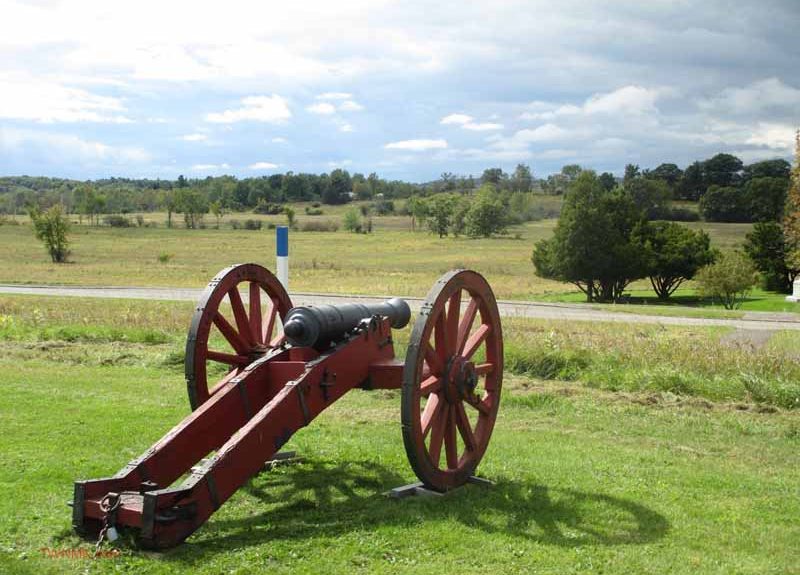
I’ve been here twice, first in 1999 and then again in 2013. The first time I didn’t take any pictures. I’ll have to get back as I didn’t realize that the surrender occurred a few miles to the north in modern day Schuylerville and did not go up there. In 2013 I wanted to see Bennington as well that day and didn’t realize that the park was closed that day.
The three pronged British campaign to split the Colonies in two had failed. One column had been turned back in western New York. Another had decided to move on Philadelphia rather than New York City. That left John Bugoyne coming down from Canada. Running low on supplies he had lost at Bennington and was now on the run. He wanted to reach a suitable place to go into winter quarters since news of the other columns had finally reached him. Albany was his destination.
The Colonists had a change in command. Out went Philip Schuyler who was doing too much retreating. In came Horatio Gates. Stirred by the recent victory at Bennington militiamen were coming in by droves. George Washington also sent some of his top commanders, Benedict Arnold and Benjamin Lincoln as well as some of his best troops in Dan Morgan and his Virginia Riflemen. Gates began moving north on September 7 and reached the heights overlooking the Albany Road about 10 miles south of Saratoga (modern day Schuylerville). Colonial engineers under Tadeusz Kościuszko were busy building fortifications.
Saratoga is actually two separate battles occurring over the same ground about three weeks apart. Burgoyne’s army arrived on September 18. Despite their advantage of position all was not well with the Colonists. Arnold and Gates were a loggerheads but the situation had not yet reached its boiling point. With fighting imminent Arnold was given command of the Colonial left and the heights there. Buygoyne placed his army into three columns, Baron Riedesel on the left with the artillery along the road, James Hamilton in the center with four regiments and Simon Fraser who was tasked with flanking the Colonists on the right.
Gates expected a frontal assault but Arnold worried about a flanking maneuver and wanted to move troops into the woods on his left flank. Gates allowed Dan Morgan’s Riflemen to conduct a reconnaissance in force near John Freeman’s farm and Morgan’s men saw British troops in the open field, the lead elements of Hamilton’s force. Morgan’s marksmen began picking off British officers and charged headlong into the British, unaware of the force coming their way. Fraser arrived as Morgan was being driven back.
Learning that Morgan was in trouble reinforcements were sent his way. Fighting swayed back and forth all afternoon. Morgan’s marksmen continued to target British officers and at one point Hamilton’s force broke. Burgoyne ordered Riedesel to send as many men as he could to help and Gates also moved men from his right to counter Fraser who was now turning Arnold’s flank. Darkness though was not far away and it allowed the Colonists to slip away into their defenses. Burgoyne had won but it cost him 600 soldiers that he could not afford to lose. The Colonists lost about 300 men.
Burgoyne pursued the Colonists to their fortifications. He now came in contact with Henry Clinton, the commander of troops in New York City who said he could begin a campaign up the Hudson to come to his aid. Clinton began moving on October 3 but it would take time to reach Burgonye. On the Colonial side reinforcements arrived led by Benjamin Lincoln, who had waged an unsuccessful campaign against Fort Ticonderoga unbeknown to anyone on either side.
Then tension between Arnold and Gates continued. In Gates’ report to Congress he failed to mention Arnold at all. The soldiers gave credit to their successes to Arnold, who directed the battle while Gates sat in his tent. It reached a head with a shouting match between the two and Arnold being relieved of command. On the British side all was not peachy either. Supplies were running short and it was becoming apparent that Clinton was not coming. Riedesel and Fraser urged a retreat but Burgoyne would not hear of it. He decided to assault the Colonial left with 2,000 men on October 7. The only problem was that the Colonial force now numbered 12,000 men and Gates knew that Burgoyne was in trouble as deserters were leaving the British army. He also had in his possession Clinton’s correspondence sent to Burgoyne.
Fraser’s men led this attack, advancing into Barber’s wheat field and Fraser was in trouble immediately with 8,000 Colonial defenders there. The opening shots came about 2 PM and resulted in heavy loss to the British. The Colonists counterattacked and captured many men and their artillery. On the left Morgan’s Riflemen were holding off Fraser’s larger force. Fraser was hit and his attack was broken up. Burgoyne himself was nearly killed as well.
Arnold could not contain himself anymore and joined the battle. Two British redoubts anchored the British defenses, Breymann’s and Balcarres’ Redboubts were defended by a few hundred men with some Canadian troops in between. Arnold decided to lead a charge against these positions. Balcarres held so Arnold moved to Breymann’s and this was taken. Arnold though was hit in the leg and carried off on a stretcher. The British camp was now vulnerable but darkness set in.
Burgoyne now had to retreat. He had lost a further 700 men in the second battle and was now outnumbered 3 to 1. He retreated to Saratoga with Gates following and surrounding him on October 13. Burgoyne surrendered four days later.
Saratoga changed everything. A large British army was now off the board. The British also learned that the Americans could fight a stand-up European style battle. So did the French, who as no friends of the British, soon entered on the side of the Colonists. Gates’ star was on the rise and he believed that he should have overall command of the Continental Army instead of George Washington. Arnold also had his honor and seniority restored but the resentment from Saratoga would linger with him and eventually make his name synonymous with treason.
The battlefield today is preserved as Saratoga National Historic Site.