In late 1864 only one seaport remained open to Confederate blockade runners: Wilmington, North Carolina. Wilmington was only open because of Fort Fisher which controlled the Cape Fear River. If the fort fell the Confederacy’s days would be numbered and its defeat certain, not that it wasn’t already. This fact did not escape the Lincoln Administration. Beleaguered general Benjamin Butler was selected to lead the assault on the fort in December 1864 giving the politician one last chance to prove his worth. Grant wanted Godfrey Weitzel to lead the attack but Butler commanded the department and received command. He brought two divisions from his Army of the James and was escorted by the largest fleet yet assembled during the war under David Porter.
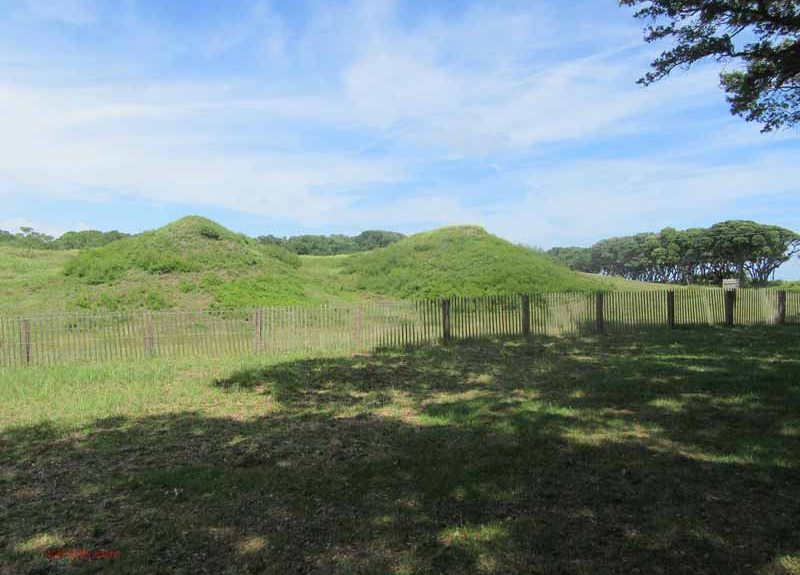
Fort Fisher
Butler planned on filling the USS Louisiana with powder and blowing it up near the fort’s seawall and he hoped that the explosion would demolish the fort. Few, including Porter, believed the plan would succeed but it was approved. The navy expedition left early since it had to tow the seaworthy monitors which required a slower speed and calmer seas.
Fort Fisher was formidable. Constructed by William Whiting in 1862 William Lamb was in command of the fort and its 1,400 man garrison, it had a 10 foot parapet and a network of bombproof shelters. Obstructions like torpedoes (land mines), abatis and deep ditches would slow any attacker and with more than 50 heavy cannon it could repel any naval assault. Robert Hoke’s Division had also arrived in the area and was available for reinforcement.
Butler’s transports were the first to arrive at the fort as Porter’s ships had to refuel. A storm on December 19 had caused them to scatter further slowing down the campaign. Porter began the attack on December 22 and sent the Louisiana in but it exploded too far offshore to do any damage. The following day Porter’s fleet got closer and unleashed a terrible barrage of shells. They fired 10,000 a day but did little damage to the fort. Butler’s transports arrived that evening.
When Butler found out that the Louisiana had already been exploded he was furious and believed that it tipped his hand. He landed a reconnaissance force under Adelbert Ames who captured a battery and accepted the surrender of two regiments his force cut off on Christmas Eve. Ames’ scout believed that the fort could be attacked but Ames was recalled by Butler who did not think the fort was damaged enough. With Hoke only a few miles to the north he did not believe that an assault was feasible and his expedition returned to Hampton Roads accomplishing nothing.
Grant was not pleased and was only to happy to relieve the relatively incompetent Butler of command. Edward Ord, a professional soldier, would take command of the Army of the James and Alfred Terry, another professional, was selected to lead the next expedition. Lamb had lost about 650 men during the raid, mostly the men who surrendered to Ames so few actual battle casualties. He was convinced that the Federals would be back but his superiors were not and Hoke was sent on an expedition to recapture New Bern.
Terry returned in Janaury 1865 with 9,000 men. Lamb’s force was increased to 1,900 and William Whiting took personal command. This time Terry made careful plans with Porter. A division of the USCT would block Hoke from coming to the fort’s rescue. Ames would take the other division and assault the fort from the land side. Porter would send 2,000 sailors and marines to attack the sea face. Terry’s men began landing on January 13 and moved south toward the fort the next day.
On January 15 the gunboats opened up a barrage. Hoke sent 400 reinforcements to the fort but was unwilling to bring his entire command. The marines landed with the sailors and began the assault. It turned into nothing more than a mob and they took heavy casualties but this attack did draw Confederate attention away from Ames who sent his men in at 2 PM. His men cut through the abatis and fought their way into the fort. The Confederates turned some of the cannon on them but Ames sent in more men and hand-to-hand fighting broke out. Whiting was killed leading a counterattack as overwhelming Union numbers began to take its toll. Lamb was getting every man out of the hospital for the fort’s defense but was wounded himself.
The naval bombardment continued and the fighting lasted well into the night. Lamb sent a plea for reinforcements but the overall commander believed it was overreaction and only sent Alfred Colquitt to relieve Whiting. Colquitt was in for a surprise when he arrived at the fort. Ames had captured most of the fort and it was just a matter of time until the rest fell. One last traverse was captured and Colquitt beat a hasty retreat to his boat and left. The fort surrendered just before 10 PM.
The Confederacy was now cut off from the outside world. In Washington Benjamin Butler was testifying before the Joint Committee on the Conduct of the War declaring Fort Fisher to be impregnable when news arrived of its capture. Wilmington would fall a month later. 51 soldiers, sailors and marines were awarded the Medal of Honor for their actions.
Ames and Porter lost about 1,000 men. The fort was a complete loss. About 600 were killed or wounded and the rest were surrendered. Of course the bigger loss was the last open port of the Confederacy. Its days were numbered. Parts of the fort still remain as part of Fort Fisher State Historic Site.