After completing the March to the Sea William T. Sherman was ready to head north. U.S. Grant wanted to put his army on transports and bring it to Virginia to help against Robert E. Lee around Petersburg but Sherman had other ideas and offered to march his army north through the Carolinas. It would allow his men to forage liberally and to bring the war to South Carolina, which many of his men held responsible for the war. They would only be too happy to put that state to the torch and they did.
Joseph Johnston was returned to command of what remained of the Confederate Army of Tennessee and began moving to try to stop Sherman and his 60,000 men. Johnston and Jefferson Davis had an antagonistic relationship but it was either Braxton Bragg or him and the army did not like Bragg. He was drawing troops from all over South Carolina and North Carolina and cobbled together an army of about 22,000 men.
Sherman’s men crossed into North Carolina on March 8 and the torches were put out as North Carolina was one of the last to secede and was to be treated differently. Sherman’s army was divided into two wings to speed up the march under Oliver Howard and Henry Slocum. They marched towards Goldsboro not expecting any Confederate resistance. At Goldsboro Sherman expected to join with the forces of John Schofield’s and Alfred Terry’s commands and continue north with a larger and more powerful force.
Johnston’s new Army of the South was looking for an opportunity to strike before that concentration could happen. His map showed that the two wings would be about 12 miles from each other near the village of Bentonville, or about a day’s march. He could destroy one wing and then turn on the other and targeted Slocum’s Wing first. There was just one problem, his map was wrong.
Johnston attacked on March 19. Slocum believed that he was fighting only dismounted cavalry at first since he did not believe Johnston would fight with the Neuse River to his rear and reported such to Sherman. He would attempt to brush the cavalry aside and moved William Carlin’s division to attack it with James Morgan’s division to its right. Morgan’s men were began to construct breastworks. Carlin was not facing dismounted cavalry but infantry instead and his attack was repulsed with more of Johnston’s men were arriving on the field.
At 3 PM Johnston attacked and drove Carlin’s division from the field and then turned on Morgan, who was surrounded on three sides. The Confederate assaults were uncoordinated and Morgan held in what became known as the Bull Pen. Union reinforcements arrived and brought the Confederate attack to a halt. Fighting continued into the night but around midnight the Confederates pulled back and began entrenching.
Johnston did not pull back on March 20. He claimed he remained to secure his wounded but most believe that he hoped that Sherman would attack him and he nearly got his wish. Joseph Mower asked for permission to conduct a reconnaissance and drove his division into the Confederate rear on March 21. William Hardee, who commanded the Confederate left assembled a motley defense and brought Mower to a halt. Hardee’s own son was killed during this action. Mower was recalled by Sherman, who realized that he missed a golden opportunity after the fact when Johnston had already retreated towards Raleigh.
Sherman lost about 1,600 men. Johnston lost about 2,600 men. Johnston realized that his entire force could not stop even three of Sherman’s divisions and knew that he could not do anything more than annoy Sherman at this point. Sherman continued on his way and occupied Raleigh soon after. The war for the most part was lost but Jefferson Davis was not yet ready to concede defeat.
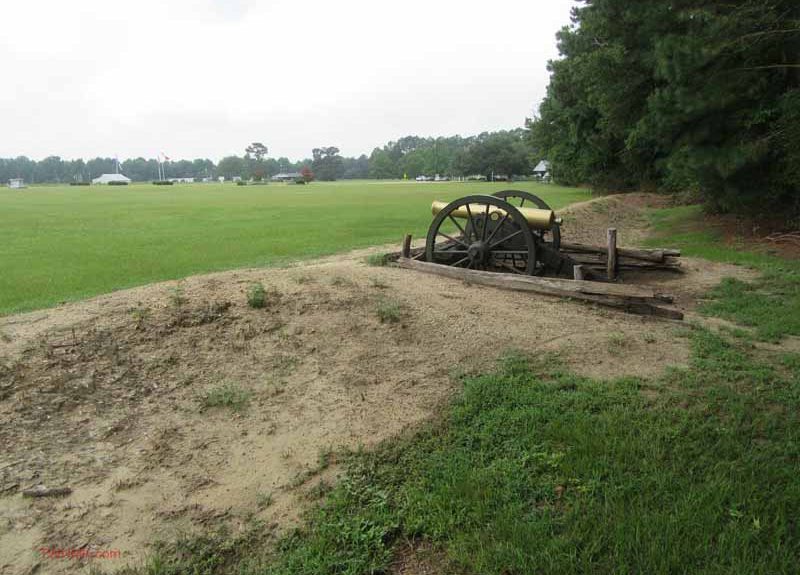
Bentonville is preserved as a part of the Bentonville Battleground State Historic Site. It was the largest battle that took place in North Carolina.