When William T. Sherman’s army got across the Chattahoochee River on July 20 there were few obstacles remaining between him and Atlanta. His maneuvering to get Joseph Johnston away from Kennesaw Mountain had prompted another retreat from the Confederate commander and it would up costing Johnston his job. Johnston was replaced with John Bell Hood.
Johnston’s men were sorry to see him go. They liked him because he did not throw their lives away recklessly. Hood had a reputation as a hard fighter but had already demonstrated his reckless behavior only a few weeks before at Kolb’s Farm. Jefferson Davis though wanted a fighter who would not give any more ground willingly. Davis got that.
Peachtree Creek
Johnston had pulled his army back across Peachtree Creek just to the north of the city. He was planning on striking George Thomas’ Army of the Cumberland which was isolated from the rest of Sherman’s army when he received the telegram relieving him of command. Sherman had split his army to destroy railroads and cut Confederate supply lines. Hood now had an opportunity to strike and kept Johnston’s plan hoping to catch Thomas while he was crossing the creek.
On July 20 Thomas’ men crossed Peachtree Creek and once across they began preparing defensive fortifications. The right and the center were strong but Thomas’ left was manned by only one division of Oliver Howard’s IV Corps. The rest of the corps had remained with Sherman. Hood saw an opening but needed to strike before the works were completed. William Hardee would hit the vulnerable Union left and A.P. Stewart would hit the Union right. His other corps under Benjamin Cheatham would monitor the other Union forces in the area.
Hood wanted the attack to come at 1 PM but a miscommunication with Hardee prevented that. Hardee was ordered to maintain contact with Cheatham and when Cheatham moved Hardee with with him and slid his men further to the east. This continued until 3 PM and at 4 PM the assault finally went forward. Hardee’s men were repulsed with heavy losses but Stewart had some success. His assault briefly drove Union defenders from their works and captured a battery of artillery but a Union counterattack along with artillery fire drove the Confederates back.
Hardee was moving his final division to attack when he received orders from Hood to stop and dispatch that force to Cheatham who needed help. This battle was a sign of things to come. Thomas lost about 1,700 men. Hood lost about 2,500. The Confederates could not afford battles like that.
Like nearly all of the battlefields in the Atlanta area this has been lost to development. Mich of the fighting took place in what is now the Tanyard Creek Park. Some plaques orient a visitor to what happened here.
The Battle of Atlanta
Hood had to keep the pressure on Sherman as James McPherson’s Union Army of the Tennessee was closing in on Decatur on the east side of Atlanta. On July 22 Hood ordered Hardee and Cheatham to move to stop him and once again it took Hardee longer than expected to get into position to attack. McPherson also expected an attack, especially on his left, and sent reinforcements from John Logan’s XVI Corps to bolster it. Sherman wanted those men to rip up the railroad but allowed McPherson to move them.
Hardee did not expect to run into a strong Union force when he finally went forward. If he had attacked when it was planned he would not have. If he had waited only an hour more he would not have, as Sherman wanted them back for tearing up the railroad. Hardee drove a Union brigade from Decatur but was unable to capture the wagons.
Cheatham and Hardee’s force now formed an L-shaped line around the Union defenses. Hood intended to hit the flanks but most of the fighting took place in the center on Bald Hill where Union artillery controlled the hill and was shelling Atlanta from it. Frank Blair’s XVII Corps held Bald Hill and repulsed numerous attacks but Cheatham’s men were able to break through Logan’s line and push his men back. Logan himself rallied them and counterattacked.
The Confederates did not have the strength to break the lines and Sherman now settled down for a siege which would continue for over a month as his cannon would rain destruction down on the city. Again the Confederates took unsustainable casualties. Hood lost about 5,500 men. McPherson lost about 3,400.
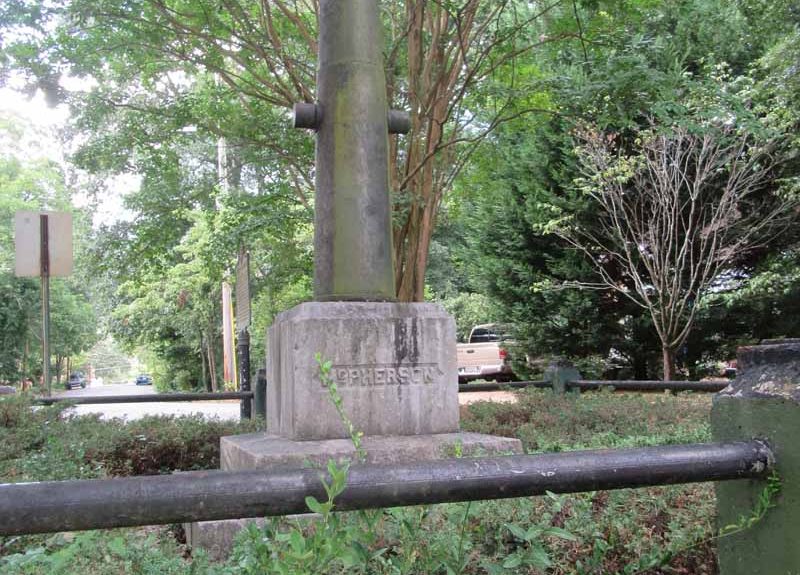
Much of the battlefield has been lost. In fact all of it has been lost. The Bald Hill is the I-20 interchange with Moreland Avenue. Two monuments were erected. One honors Confederate Major General William Walker who was killed assaulting the Union lines. The other honors McPherson, who rode into Confederate lines and was killed while escaping. He was the only Union army commander to be killed during the war and his death caused even U.S. Grant to break down as he was close to McPherson.
Logan took command of the Army of the Tennessee. Logan was a politician but was a capable general and his think black mustache earned him the nickname “Black Jack.” Sherman wanted West Pointers in command and eventually placed Oliver Howard in charge. Logan was disappointed and disgusted but remained with his corps. He would give Sherman trouble much later in life when Logan was a powerful politician and Sherman was general-in-chief of the army. The other high ranking loss was Joseph Hooker, commander of XX Corps. He had blamed Howard for the loss at Chancellorsville and the loss of his prestige and believed the command should have gone to him. He threatened to resign and Sherman was only too glad to see him go. Henry Slocum, another eastern general who had refused to serve under Hooker, was brought in to take command of the XX Corps.
Ezra Church
The Siege of Atlanta was not working. Sherman needed to cut the rail lines and he selected the line coming from Macon as a target at its junction at East Point. In late July Howard with the Army of the Tennessee was to swing around Atlanta to the north and west to get at it. Hood anticipated this and moved to meet them.
Hood was outnumbered and wanted to hit isolated portions of Howard’s army and he believed that surprise would lead to victory. The clash came near Ezra Church but Howard was not surprised. He knew Hood. The two had attended West Point together and Howard’s men were behind breastworks when Hood attacked on July 28 with the corps of A.P. Stewart and Stephen Lee.
The attack was repulsed in one of the more lopsided affairs of the campaign. Hood lost about 3,600 more men. Howard lost about 550 and Stewart himself was wounded. The attack did bring Howard’s movement to an end and the railroad remained in Confederate hands for the time being.
Like the other battlefields this one too has been lost to development. This site of the battle is at Mozley Park and does have a few plaques to orient a visitor.
Utoy Creek
Sherman continued to try to get at East Point. John Schofield’s Army of the Ohio was moved to join Howard and John Palmer’s XIV Corps from the Army of the Cumberland was following. They took up position along Utoy Creek on August 2 but did not cross it.
On August 4 Schofield and Palmer crossed and the Confederates attacked with part of Stephen Lee’s Corps and were repulsed. A cavalry feint was tried to delay Palmer and Schofield linking up but was also unsuccessful. The following day Schofield attacked. His attack was successful but his forces were disorganized and he took the rest of the day to regroup them. Lee’s men were able to use this time to strengthen their defenses. Schofield resumed the attack the next day and this time was repulsed with heavy losses.
Schofield’s offensive was blocked and East Point remained in Confederate hands. His men moved to the right but were shadowed by Lee and he was never able to get around them. With this failure Sherman decided to go right for the Confederate supply line with everything he had.
Schofield lost about 850 men in the battle. Lee lost about 35. Like other battlefields in the area it has been swallowed up by development. Part of the battlefield is in the Cascade Springs Nature Preserve which has numerous walking trails through it that do go by Confederate entrenchments though those points are not marked.
Jonesboro
Sherman went for the jugular believed that if he cut the supply lines Hood would have to evacuate. By August 25 Sherman had six infantry corps in position to get at the Macon & Western Railroad near Rough and Ready. Hood sent Hardee with two corps and orders to rout the Union force. He didn’t realize the size of the attacking force.
On August 31 Hardee attacked near Jonesboro and was easily repulsed and Hood recalled one of Hardee’s corps fearing a move from Sherman on the city. On September 1 the Union broke Hardee’s line forced Hardee back to Lovejoy’s Station. Sherman wanted to bag the whole lot but was not able to do so but now Atlanta could not be held.
With the supply lines broken Hood knew he had to evacuate. Munitions and government property were destroyed in a spectacular blaze and Hood’s men marched out on September 1. The following day the city was surrendered to Henry Slocum by the mayor. Atlanta was Sherman’s and was fairly won and with that Abraham Lincoln would almost certainly win re-election.