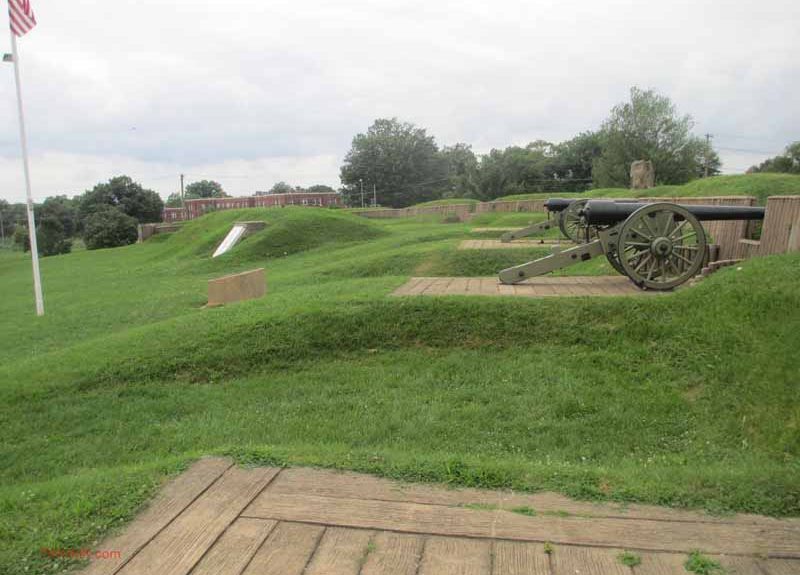
Jubal Early’s raid into Maryland sent shivers down those who were in Washington DC. U.S. Grant had removed nearly all of the soldiers stationed around the city to help his push on Richmond. Washington was the most heavily fortified city in the world but few were there to man those defenses and on Early’s approach prominent residents fled the city. Abraham Lincoln chose to remain but a steamer was docked and ready to leave the city at a moment’s notice.
On paper 31,000 men were stationed to defend Washington under the command of Christopher Augur. 87 fortifications were built north of the Potomac with nearly 500 heavy cannon and supposedly manned by about 14,000 men. In reality many of the soldiers were new recruits or were unfit for duty. The best estimate for the number of defenders for the whole city was about 10,000 men. War Department clerks were being trained and armed. The situation seemed desperate. What the Union army did not lack was generals though as numerous generals were in the city awaiting commands. Alexander McCook, looking for a command since he was relieved the autumn before, was given command of the defenses.
Early had with him about 10,000 men and he was heading for Washington. He spent one day fighting the Battle of Monocacy just south of Frederick on July 9 and by July 11 he was within site of the city. He scanned the defenses but it was late in the day so he delayed the attack until the following day. His men were tired and he was unsure of the strength of the defenses but his men also spent time looting Montgomery Blair’s mansion in Silver Spring and some of his men got drunk.
The Union line of forts looked strong. Union defenders occupied a line from Fort Lincoln to Fort Sumner. Hidden behind the defenses in a reserve position was 10,000 men under Horatio Wright and his VI Corps. They had arrived just in the nick of time that night from Petersburg at about the same time as Early and marched out to the defenses. They eventually were moved into the defenses with the hope that veteran troops would bolster the less experienced men.
Skirmishing began around 3 PM as Early began to probe the defenses. Wright’s men moved into the fortifications now. Confederate cavalry pushed through the skirmish line but artillery in the fortifications allowed for no weak spots. Early determined that he could not carry the defenses without huge losses and pulled back. Wright attacked and drove Early off.
In Fort Stevens there were some notable observers. Abraham Lincoln and his wife came to observe the fighting. They briefly came under fire and a surgeon standing near him was wounded. Legend has it that future Supreme Court Chief Justice Oliver Wendell Holmes did not realize that he was standing next to the president and told Lincoln to “get down you damn fool.” It is the only time in our nation’s history that a sitting president has come under fire.
The casualties were light on both sides, around 400 for each side. Washington was of course secured and would not be threatened again for the remainder of the war. Early pulled back towards Frederick and Hagerstown and dispatched his cavalry to burn Chambersburg, Pennsylvania. His men made it as far west as McConnellsburg before turning south and heading into Virginia. Now, with an opportunity to destroy an isolated portion of Robert E. Lee’s army U.S. Grant decided to take the chance and sent Phil Sheridan to do it.
It is notable that the fighting took place in Washington DC. The remains of Fort Stevens have been partially preserved and many of the other sites of the forts are city parks.