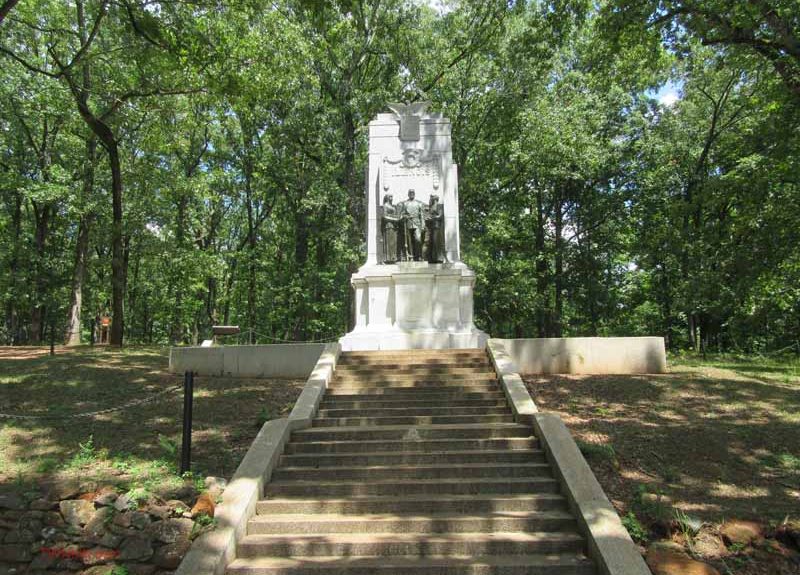
There are many large hills between Dalton and Marietta in Georgia. There is only one between Marietta and Atlanta, Kennesaw Mountain. In modern time the skyscrapers of Atlanta can be seen on a clear day from there. Kennesaw is actually three different hills, an upper and lower mountain and a small one called Pigeon Hill. Another ridge to the south became known as Cheatham Hill. It was the last natural fortress that Joseph Johnston could use to stop William T. Sherman’s advance on Atlanta.
Sherman had tried to move off to the southwest to cut the railroads around Atlanta but had come to grief in the Hell Hole. He now moved back to his supply line to the northeast. Joseph Johnston put his men into what was called the Brushy Mountain Line which contained Pine Mountain, Kennesaw Mountain and Brush Mountain. Rain began to fall in early June and Sherman stopped movements until it stopped. It took eleven days but on June 14 Sherman resumed the offensive.
Pine Mountain
On June 14 Confederate corps commander Leonidas Polk was on a personal reconnaissance mission on Pine Mountain. His entourage attracted a Union artillery battery which fired on him. Polk took a direct hit and died instantly. Johnston then removed his men from Pine Mountain and pulled them back to Kennesaw. Sherman’s men were moving in and began to probe the new line for weaknesses. Kennesaw Mountain could not be assaulted. It was too steep and the cost to take it would be too high (if it could be done) Sherman determined. But he could demonstrate against it to keep the Confederate soldiers pinned there while he attacked elsewhere. George Thomas’ Army of the Cumberland was selected for this job. Josesph Hooker’s XX Corps was moved to their right and John Schofield’s Army of the Ohio would move in on his right.
The spot where Polk was killed is marked by a small monument. The rest of Pine Mountain has been taken over by houses and the vista it offered is no more.
Kolb’s Farm
Eight days later another of Johnston’s corps under John Bell Hood tried to get around the Union flank near Peter Kolb’s farm. Johnston had anticipated Sherman’s movements and had Hood in place by June 22. Hood advanced Carter Stevenson’s Division which ran into two Union regiments near the Kolb Farm. Hood made an assumption that was wrong, either that he was beyond the Union flank and could roll them up easily or that the Union troops were in marching column and would make for easy pickings. Instead his cavalry found a considerable infantry presence but by the time they reported this fact it was too late. Hood moved his entire corps of 14,000 men forward.
Hooker was ready for him and he had about 15,000 men to defend his position. Hood’s assault hit at 5 PM. The two regiments encountered earlier stood bravely but were forced back. When Stevenson’s Division crossed the Powder Springs Road Hooker’s artillery opened on them near the farm. Hood’s attack elsewhere did little better and his men fell back. This assault cost Hood about 1,500 men while Hooker lost about 350. It should have given pause later when Hood would rise to command the army about his impetuous and aggressive nature but it didn’t.
Hooker reported the repulse to Sherman and that he was worried about his right, or where Schofield was. Both Sherman and Schofield were enraged and had a meeting with Hooker the following day leaving a reprimand against Hooker. While his men had bore the brunt of the fighting during the campaign Hooker’s star was now falling.
What is left of this battlefield is preserved as a part of Kennesaw Mountain National Battlefield Park. A parcel of land from the Kolb Farm is all that remains. Suburban sprawl from Atlanta has swallowed the rest up.
Kennesaw Mountain
Sherman was displeased with the Army of the Cumberland. It was a strong fighting force but as soon as the firing (or any perceived threat) started it would stop and begin entrenching. Sherman wanted mobility and Thomas’ army was starting to slow him down. Despite dismissing an attack on the mountain as impossible he decided to try it anyway. Thomas and James McPherson’s Army of the Tennessee would hit the entrenchments in the center on Little Kennesaw Mountain and Pigeon Hill while Schofield would demonstrate to keep the Confederates elsewhere busy.
On June 27 at 8 AM over 200 cannon opened a massive bombardment. The infantry moved forward about 30 minutes later. John Logan’s XV Corps advanced on Pigeon Hill against William Loring’s Corps. If the Union attack would be successful Loring would be trapped on the mountain. The steep and rocky cliffs of the mountain slowed the attack. Some attackers made it to the abatis but no further. The assault was repulsed with what was considered to be a useless waste of life.
Thomas would assault William Hardee’s line about two miles to the south at what became known as Cheatham Hill. A salient in the Confederate works was here and offered the best chance of success. His assault against the west end of the salient began at about 9 AM and was repulsed with heavy casualties. The next came from the south and crossed a wheat field below the works. This attack made it to the Confederate works and hand-to-hand fighting ensued but they could not break though. This brigade, Daniel McCook’s, was decimated. McCook was killed and nearly all of the field officers were down. The next brigade in line fared little better.
The fighting at what became known as the Dead Angle died down just before 11 AM. The Union troops there were trapped, they could not retreat without being shot and the safest place to stay was where they were and wait until nightfall.
The only success of the day came from Schofield who put men across Ollie’s Creek and opened the way to the Chattahoochee River. The assaults cost Sherman about 3,000 men. Johnston lost about 1,000. Sherman was not concerned with the losses and tried to get Thomas to continue the attack. Thomas refused. Kennesaw was a costly disaster for Sherman and one has to wonder if he learned his lesson. This was the last full scale assault he would make against an entrenched position for the remainder of the war. Sherman resumed his flanking movements on July 8 and Johnston was forced to abandon Kennesaw. The withdraw from here was just about the last straw for Jefferson Davis who would soon relieve Johnston of command and elevate Hood.
The battlefield today is preserved as a part of Kennesaw Mountain National Battlefield Park. Walking trails and a driving tour are available and the mountain as well as Pigeon Hill and Cheatham’s Hill are open to the public. This is the only battlefield in the Atlanta area that is a part of the National Park Service.