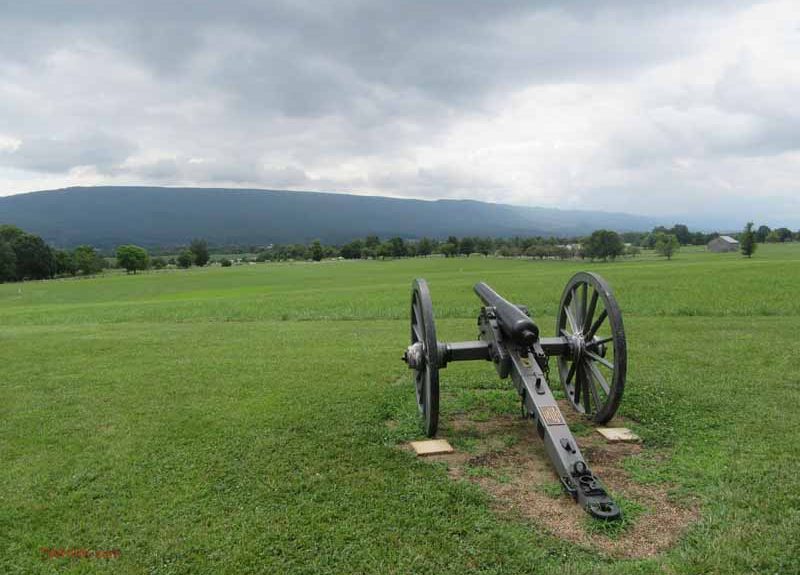
If you are from the Shenandoah Valley New Market is a battle steeped in lore. It may be the most significant small battle of the war and for one university it is celebrated every year.
One prong of U.S. Grant’s offensive in May of 1864 was to invade the Shenandoah Valley, the breadbasket of the Confederacy. Franz Sigel was given command of this offensive. Sigel was popular among many German immigrants and had served in both the eastern and western theaters displaying very little competence. But he was popular with his men and with an election looming Abraham Lincoln could ill-afford to make enemies out of the German-American population so Sigel remained. He had about 9,000 men and was tasked with advancing up the Valley to Staunton where he would link up with another Union column under George Crook.
John Breckenridge commanded the Confederate forced in the Valley. Like Sigel he had seen action in the western theater. Breckenridge was a Kentuckian, a former U.S. Vice President and was a candidate for president in 1860. When word of Sigel’s advance reached him he began to cobble together all of the forces that he could. He had about 4,000 men and decided to move north and attack Sigel rather than wait for him to reach Staunton.
On the evening of May 14 Sigel and about 6,300 men reached the village New Market. Breckenridge was about 8 miles to the south and began marching at 1 AM on May 15 to reach Sigel with hopes of trapping him. About mid-morning the two forces collided. The main Union line centered on Manor’s Hill, a large open rise just south of town and between the Valley Turnpike and the Shenandoah River. Breckenridge moved to attack but first tried to lure the Union into assaulting him. The commander on site, Augustus Moor did not take the bait so Breckenridge launched his assault around noon.
Confederate cavalry got into the Union rear and Breckenridge’s attack began to push Sigel’s men off of Manor’s Hill and through the farm belonging to Jacob Bushong and further to a hill to the north of the farmstead. After a lull to redress the ranks Breckenridge resumed the assault. This time the Union defenders held firm and drove some Confederates back in confusion. A gap in the Confederate line was created and Breckenridge ordered his last reserve, the VMI Cadets, up to fill it.
Sigel now launched a counterattack but it did not go well. His cavalry was repulsed easily and his infantry followed suit. His commanders may have been confused as Sigel was heard to be giving orders in German rather than English. Breckenridge renewed the attack around 3 PM with the VMI Cadets spearheading the assault through Jacob Bushong’s orchard and due to the soft wet ground many of them lost their shoes. They continued on through what would become known as the Field of Lost Shoes, and this assault forced Sigel’s line to break. His men began to pull back and abandoned 5 cannon on the field. Only a late arriving battery with two infantry regiments slowed the Confederate pursuit.
Sigel organized a rear guard on Rude’s Hill and eventually pulled his men across the Shenandoah River to Mount Jackson. He had lost about 840 men. Breckenridge had lost about 475, including 47 VMI Cadets with 10 Cadets being killed or mortally wounded. Even today when VMI celebrates New Market their names are called on the roll and a cadet responds that they died of the field of honor.
When Grant learned about the battle he was furious. Sigel was immediately replaced with David Hunter, who would later burn the library at VMI in a future raid. Sigel’s military career was essentially over. For the Confederates the victory was a huge boost. Crops could be harvested in the Valley and some of Breckenridge’s men could be sent to aid Robert E. Lee outside of Richmond. Breckenridge himself was compared to Stonewall Jackson by some of the press.
The battlefield is preserved today as the New Market Battlefield State Historic Site and the Virginia Museum of the Civil War.