Following the Battle of Chickamauga the situation for the Union army was desperate. They had been driven back into Chattanooga and had allowed the heights around the city to be occupied by Braxton Bragg’s army. Bragg did not have the strength the drive the Union out of the city but he could starve them out. He controlled the river and the railroads into the city with his men positioned on Missionary Ridge and Lookout Mountain. All he needed was time.
But things were not all peachy for the Confederates. Bragg relieved two of his senior generals, Thomas Hindman and Leonidas Polk so twelve of his other senior generals petitioned Jefferson Davis to remove Bragg from command. After all, Polk was a personal friend of the Confederate president. Davis himself came down to see the situation for himself on October 4 but decided to retain Bragg. No one else was a viable replacement other than Joseph Johnston and Davis did not trust him. So vindicated, Bragg removed two other generals, Simon Buckner and D.H. Hill from command in retaliation.
For the Union the situation in Chattanooga was dire. Men were on quarter rations and horses were falling over dead from lack of food. In the outside world though the wheels were in motion. Shortly after Chickamauga 15,000 men were detached from Virginia and sent to Chattanooga under the command of Joseph Hooker. A little over a week later 20,000 men were dispatched from U.S. Grant’s army and led by William T. Sherman to help raise the siege. Grant himself was given command of the new Military Division of the Mississippi, which stretched from the Appalachian Mountains to the Mississippi River. There was one man Abraham Lincoln trusted to restore the situation and that was Ulysses S. Grant who arrived in Chattanooga on October 23.
His first order of business was remove William Rosecrans from command and replace him with George Thomas. Grant did not like Thomas but liked Rosecrans even less. Alexander McCook and Thomas Crittenden were also relieved of command shortly thereafter. The Army of the Cumberland was reorganized into two corps under the command of John Palmer and Gordon Granger. Grant’s second order of business was to open a supply line to bring in food.
Rosecrans’ chief engineer William Smith had devised a plan to open a supply line and Thomas put it into effect. Smith briefed Grant who endorsed it. If Brown’s Ferry could be taken the Army of the Cumberland could link up with Joseph Hooker’s men coming from Virginia. A small road into the foothills linked up with Kelly’s Ferry at Wauhatchie Station. By taking control of this territory this plan had another benefit in that it could threaten the right flank of any movement into the Lookout Valley.
Hooker moved quickly into the Lookout Valley with three divisions but was slowed by rain. Grant went ahead with the movement anyway and William Hazen’s brigade was loaded onto boats and sent downstream to seize the gap. Bragg was unaware that the movement was afoot but knew Hooker was coming and moved James Longstreet’s Corps into the Lookout Valley and Longstreet placed two regiments at Brown’s Ferry. Early in the morning of October 27 Hazen landed his men and seized the ferry. A report reached Longstreet about the situation but he dismissed it and did not report anything to Bragg. This gave Hazen and his supporting brigade under John Turchin time to secure their bridgehead.
Wauhatchie
The following afternoon Hooker’s column arrived. Thomas dubbed his new supply line the Cracker Line and prepared to bring in supplies but Longstreet had other plan and decided to attack Hooker near Wauhatchie. Hooker had not deployed his men in a good defensive position and placed John Geary’s division at the station to protect communications. Longstreet was amazed when he saw wagons parked there and Geary’s men in bivouac. Longstreet called in two brigades under Evander Law and Micah Jenkins to make a night attack, a rarity during the war. Despite appearances Geary was expecting an attack and was ready.
The assault came at midnight and hit hard. Hooker ordered reinforcements forward. Law was pushed back to a strong position which his men held against several Union attacks but Geary was running low on ammunition. As things were turning south for Geary Jenkins was ordered to retreat and pulled back to Lookout Mountain.
Little of this battlefield remains today, most prominent a monument to the New York soldiers under Geary who fought there.
Grant was disgusted with Hooker who had put his men in a poor situation. He was bailed out only by Longstreet’s poor planning. The Cracker Line was now open though and the Army of the Cumberland was being supplied. The situation had changed for Bragg and he now conceived of a plan to send Longstreet around Thomas’ left and join forces with 10,000 men in southwestern Virginia and move on Knoxville. Longstreet was the ideal force to send as he could then return to Virginia and rejoin Robert E. Lee when the expedition was over. Longstreet departed in early November.
Bragg still had the situation in hand. Sherman and his men were still two weeks away and the weather was only going to get worse. Sherman himself arrived on November 14 and began planning with Grant. Grant proposed that every available boat would get Sherman’s men across the Tennessee River to attack Bragg’s right flank on Missionary Ridge. If successful this would give Grant control of the two main rail lines that supply Bragg’s army. Thomas would demonstrate and pin Bragg’s left. Hooker was to attack Lookout Mountain but Grant withdrew his support for that. Sherman’s men were hampered by bad weather and Sherman had ordered them to march with their wagons which slowed them down further and his men began arriving on November 20 several days late. Grant’s plan called for the attack to begin the following day.
Bragg had no idea this was happening as his cavalry was no where around. He believed that Sherman was heading to Knoxville. With Longstreet gone Carter Stevenson was placed in command on Lookout Mountain and the Confederate left and he had three brigades placed on a bench on the mountain. It was an imposing position but not a good defensive one. John Breckenridge was in command of the center with 16,000 men to cover 5 miles. Like Stevenson his men were in an imposing position but not a good defensive position. Bragg also called for the removal of 11,000 men to send them to Knoxville to try to bag Sherman. Bragg’s mistaken belief that Sherman was heading to Knoxville was working out better than Grant could have ever hoped.
Orchard Knob
Confederate soldiers were observed to be marching away from Missionary Ridge on November 23 and Grant became concerned that Bragg was sending them to reinforce Longstreet in East Tennessee. Grant ordered a reconnaissance in force toward a small 100 foot high hill called Orchard Knob. At 1:30 PM about 14,000 soldiers moved forward and easily overran the 600 Confederate defenders. The hill now became Grant’s and Thomas’ HQ.
Bragg had indeed been sending reinforcements to Longstreet and sent recalls to all of the troops that were within a day’s march. He withdrew troops from Lookout Mountain and moved them to the now vulnerable Missionary Ridge to begin fortifying the position. Bragg chose his position poorly. His men fortified the geographical crest of the hill rather than the military crest which meant that their artillery was almost useless and they could retreat up the hill to maintain an advantageous position.
Lookout Mountain
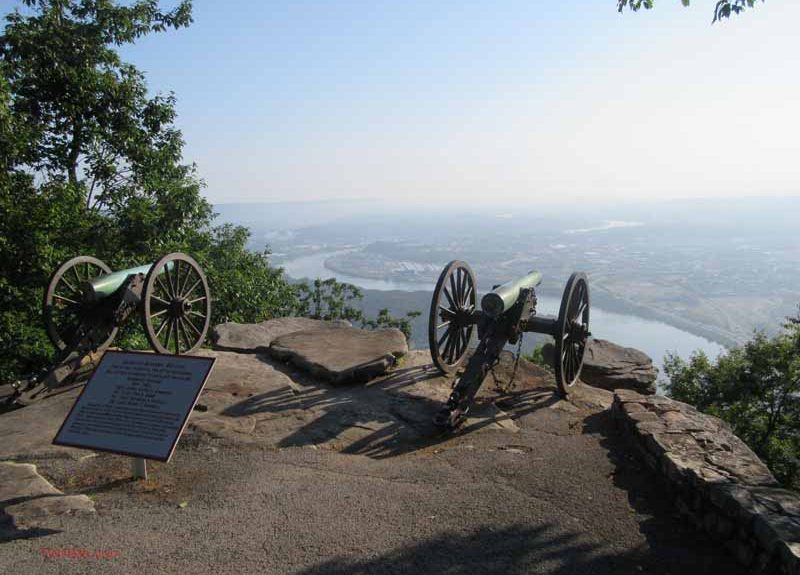
Sherman’s men were in Chattanooga by now but were unable to cross the Tennessee River as the pontoon boats had fallen apart. Lookout Mountain became the only viable place to attack as assaulting Missionary Ridge was deemed to be too hazardous. Joseph Hooker’s column would make the assault with about 10,000 men. Grant did not want a full-scale assault but more of a demonstration to see if an assault was viable but the hard-headed Hooker ignored him and ordered an attack. Hooker would attack with one of his divisions under John Geary, one of Thomas’ under Charles Cruft and one of Sherman’s (under Peter Osterhaus) which was stranded in the valley.
The assault took place on November 24 in the morning. Osterhaus was stalled crossing Lookout Creek but John Geary’s division advanced unhindered. The Confederates were badly outnumbered and were driven up the mountain to near the Craven House. One of the defenders of Lookout Mountain was the Craven’s son, who was shot and brought to his family’s house where he died.
The steepness of the mountain prevented the Confederates from bringing their whole force to bear and by 1 PM the whole Union assault force was advancing up the mountain. It was a slow go for the assaulting force though. By 3 PM a thick fog moved in with only the top of the mountain being visible. The two sides fired blindly into the fog at each other well into the early evening but Bragg knew his men could not hold the mountain and ordered a retreat. The fog cleared at midnight and with a lunar eclipse happening that night his men evacuated under cover of total darkness and were sent to Missionary Ridge.
Missionary Ridge
Sherman’s men finally got across the Tennessee River in the morning of November 24. He quickly advanced on what he thought was Missionary Ridge and took the position easily. The only problem was that it was not Missionary Ridge that he took but instead a smaller and less important rise. He looked up from there and saw the fortified Confederate position at the real end of Missionary Ridge called Tunnel Hill. A railroad tunnel had been cut through the mountain giving it its name.
The following day Grant altered his plans. Hooker was to move his men to assault Missionary Ridge from the south. Thomas would demonstrate in the center. Sherman would deliver the main blow at Tunnel Hill. Sherman was to advance at dawn and Grant had no real expectations of success for Thomas or Hooker. Sherman launched several assaults on Tunnel Hill. There is not a lot of room to maneuver and Sherman sent his men in piecemeal and never launched a co-ordinated assault. It also did not help that he was facing the best soldiers in Bragg’s army in Pat Cleburne’s Division.
By 3:30 PM Sherman was stalled. Grant ordered Thomas to move forward and drove the Confederates out of the first line of rifle pits at the base of the hill. Fire came down on them from above and the attackers realized that they could not stay where they were so some of the men began to more forward. Bragg’s artillery played little role as it was not situated correctly and could not depress their muzzles low enough. Missionary Ridge could very well have been an impregnable position but by Bragg deploying on the actual crest of the hill rather than the military crest he made a serious error.
When Grant saw Thomas’ men advancing up the mountain he was furious and Thomas was not happy either. But slowly his men fought their way up the mountain and by 4:30 PM they had broken the Confederate lines. These men had endured taunts from both Sherman’s and Hooker’s soldiers about Chickamauga and were more than willing to repay the favor to the Confederates. Panic gripped Bragg’s army and it began to flee southward back into Georgia, all that is except for Cleburne’s men. His division formed the rear guard and bought time for the retreat.
Hooker had been slow in getting into position finding burned bridges in his path. It took several hours to rebuild the 70 foot long bridge over the Chattanooga Creek. When Hooker did arrive on the field he assaulted Missionary Ridge from the south. The Confederates were being pushed back from the north and south and were eventually squeezed off of the ridge.
Pursuit was attempted. Phil Sheridan’s division made a half-hearted attempt but was not supported by the rest of the army and fell back. Hooker moved his men toward the Ringgold Gap. At 3 AM the next morning Cleburne ambushed Hooker’s column and Cleburne’s men held the gap until around noon. Grant called off the pursuit due to lack of rations.
Chattanooga was a disaster for the Confederates. Bragg lost about 6,700 men. Grant lost about 5,800 but he had driven off Bragg and had Chattanooga and its rail junction in his pocket. Like after Chickamauga Bragg sought scapegoats and relieved Breckenridge, who had been in command of the center when Missionary Ridge fell. Bragg himself would be relieved of command before the year was out, replaced by Joseph Johnston. Longstreet’s campaign in East Tennessee failed miserably and he abandoned any hopes of seizing Knoxville in early December and went into winter quarters. In Grant Lincoln now had a fighter and someone worthy of commanding all of the nation’s armies. In the spring he would become the highest ranking officer in the United States.
Orchard Knob, Lookout Mountain and Missionary Ridge are all parts of Chickamauga and Chattanooga National Military Park as is Point Park on Lookout Mountain and Wautatchie.