Following Second Bull Run the way was now clear to invade the North for Robert E. Lee. The Confederates believed that Marylanders would flock to the colors as his army liberated the state. Lee’s army though was in bad shape. Some had been fighting and marching since March and needed a break to rest. Lee could very well have done that but he and the Confederate government believed that if they could score a major victory north of Washington it would bring Great Britain and France into the war. With those hopes Lee began moving north.
Lee divided his small army into three columns. Stonewall Jackson would lead the main column against Harper’s Ferry. Harper’s Ferry was an old town built around the Federal arsenal there in 1799. It is at the confluence of the Potomac and Shenandoah Rivers but it is not defensible. It is surrounded by mountains on three sides (Bolivar Heights to the west, Loudoun Heights to the south and Maryland Heights to the east) with only a few roads going in or out. This was where John Brown had made his famous raid in 1859. The Confederates had occupied the town early in the war and removed much of the equipment for their own use but gave the town up shortly thereafter.
Lee expected that the Federals would give up Harper’s Ferry again without a shot. Many of the smaller garrisons in his way evacuated without a shot being fired but Colonel Dixon Miles in command at Harper’s Ferry was ordered to stand his ground. He had about 14,000 mostly inexperienced men under his command. Jackson would have about 23,000 veterans. For Miles this was a chance at redemption. While a career army officer, he had been disgraced at First Bull Run when he was accused of being drunk on the field. He accepted a quiet post at Harper’s Ferry to rebuild his reputation.
Lee sent James Longstreet’s wing of the army to Hagerstown. Jackson was to swing to the west of Harper’s Ferry and secure Bolivar Heights to attack from the west with 11,500 men. Lafayette McLaws was to secure Maryland Heights with 8,000 men. John Walker with 3,500 men would seize Loudoun Heights. With those secured the garrison would be forced to capitulate. The attack was planned for September 11 but Walker was late and it was pushed back to September 13.
Miles had kept his men close to town rather than taking control of more defensible terrain or abandoning the post. A powerful artillery battery was at the top of Maryland Heights but it was designed to hold off raiders and not an actual attack and about 1,600 men were placed there to support it. On September 12 the first Confederates approached here.
The following day the Confederates launched a major attack at 6:30 AM. The inexperiencd troops on Maryland Heights held their own repelling two assaults. Only when the on-site commander, Eliakim Sherrill, was wounded and carried from the field, did they become panicky and began to give ground. William Barksdale’s Mississippians got onto their flank and a rout ensued and an order to retreat came at 3:30 PM. Maryland Heights was now in Confederate hands. Soon also was Loudoun Heights, seized without a shot being fired.
Jackson arrived at the base of Bolivar Heights around 11 AM and to his surprise found many of the positions around town undefended. Miles’ subordinates pleaded to retake Maryland Heights but he believed that the town could be defended from Bolivar Heights. As the sun went down Miles sent messengers out to reach the Union lines to tell McClellan that he could hold for 48 hours. McClellan was dismayed when he received this information but he put William Franklin’s VI Corps in motion and sent couriers back to inform Miles. None made it.
On September 14 Jackson’s men manhandled his artillery into position. A.P. Hill’s Division was positioned along the Shenandoah River to prepare for a flank attack the following morning.. A brief bombardment began at 1 PM and did not last long. Again Miles’ officers pleaded to try to retake Maryland Heights and escape and they might have been successful. One lone Confederate regiment remained there, the rest had been moved north to deal with Federal attacks at South Mountain. One of the cavalry officers, Grimes Davis, proposed to take the cavalry out as it was useless there anyway. Davis believed he could get out and led 1,400 troopers out of town and to safety. They had some brief brushes with Confederate pickets but they had a secret weapon: Davis was a native Mississippian and his thick Southern drawl was enough to get his men by. On his escape he also captured James Longstreet’s reserve ordnance wagons.
By September 15 Jackson was ready along Schoolhouse Ridge. His artillery opened up and pounded the Union positions at the Chambers Fam. An infantry assault began at 8 AM and Miles realized that the situation was hopeless. Miles officers still wanted to cut their way out, they believed that they heard their own artillery getting close. After discussing this with his officers an artillery shell exploded near Miles tearing off his leg. His men were so disgusted with him that many refused to even take him to the hospital where he died the next day. The garrison surrendered shortly thereafter.
For the Union this was a disaster. They had lost about 210 men in combat and surrendered over 12,000 men. This would be the largest surrender of US forces until World War 2. The Confederates lost about 280 men. The hungry Confederates feasted on Union supplies and 73 artillery pieces were captured, a major haul that immediately upgraded the Confederate inventory.
Most of Jackson’s men now began marching toward a new threat near Sharpsburg. A.P. Hill’s men remained behind to oversee the paroling of the prisoners with orders to proceed to Sharpsburg when it was done. They would arrive without a moment to spare.
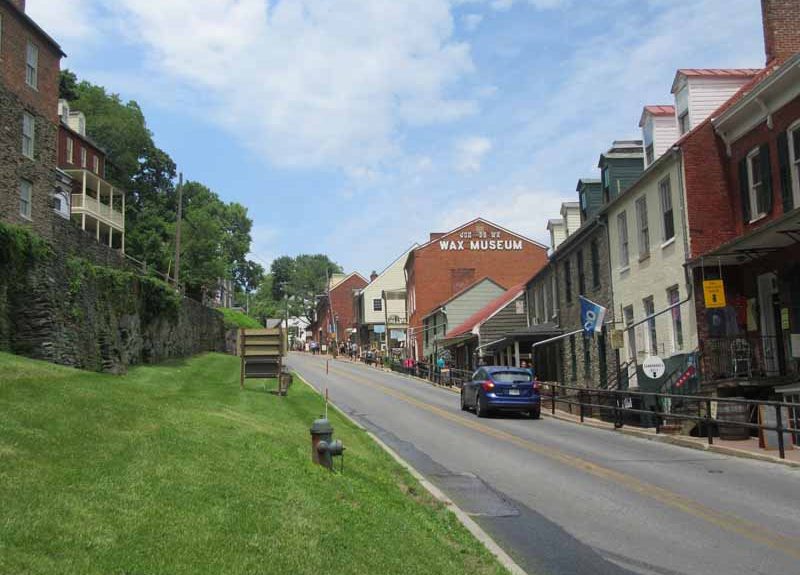
Much of the town and battlefield is preserved today as the Harper’s Ferry National Historic Site.