The British were stuck in Boston under siege from 15,000 angry colonists. While the Colonists were able to block the land approaches they had no way of stopping the Royal Navy meaning they could not prevent resupply and reinforcements from arriving. Across the Charles River was a series of hills that the Colonists could use to place artillery, if they could get some, that could make life difficult for the British. Fortunately for them, Henry Knox had some that he had captured at Fort Ticonderoga and it was on its way.
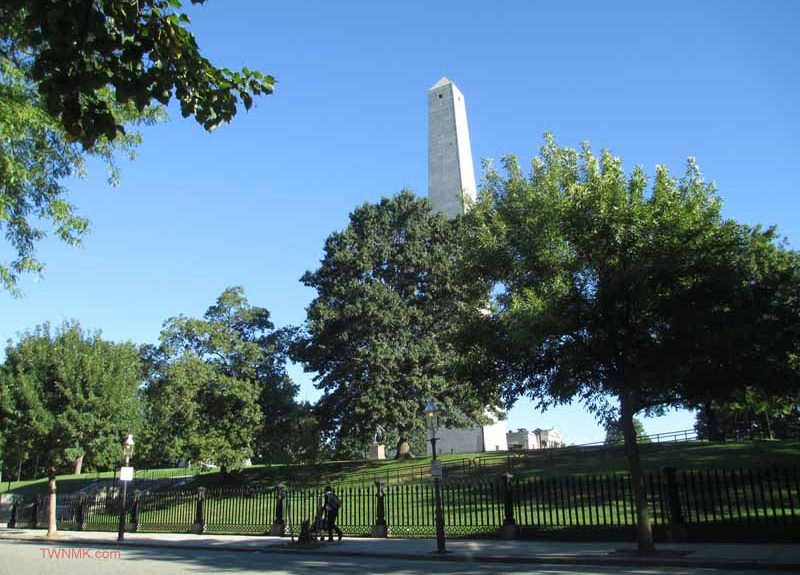
Thomas Gage had not fortified these hills, instead choosing to fall back. Bunker Hill is about 110 feet in elevation and the small town of Charlestown was at its base. By May 6,000 British soldiers were in Boston and Gage began a plan to break out. Dorchester Heights to the south would be taken first and then Bunker Hill, where Israel Putnam was sent to continue to fortify the hill and nearby Breed’s Hill was also incorporated into the defenses. This hill was more defensible and offered a better view of the city so the main redoubt was constructed here.
The efforts on Breed’s Hill drew the eye of the British. The Royal Navy opened fire on them to little effect. This fire did reveal a weakness to Putnam who realized his redoubt could be flanked on either side. The British commanders met to plan an assault. The man who’s soldiers would make the assault, William Howe, believed that it would not take much effort to disperse the rabble. It took six hours to bring the attacking force together, review it and transport it to the other side of the Charles. They arrived at the base of the hill at 2:00 PM. Howe would lead a flanking assault around the left, Robert Pigot would lead the main assault on the center and John Pitcairn led the reserve. The arrival did not go unnoticed by the Colonists.
Colonial reinforcements also began arriving, extending the defenses to the Mystic River. At 3 PM the first British assault began. The Colonists waited until the British got close and inflicted heavy losses on them. A second assault with Pigot’s men leading was tried and had the same results. Howe called for reinforcements from Boston and began a third assault on the main redoubt. By this time the Colonists were low on ammunition and confusion was in the Colonial rear. Reinforcements were few and far between and they also lacked bayonets and began to fall back towards Bunker Hill and then by 5 PM to Cambridge ceding the position.
The British victory was costly, over 1,000 total casualties and included a large percentage of the officer corps in North America. The Colonists lost about 450 men and five of their cannon. When he heard about the casualty figures, George Washington gained hope that indeed his citizen army could win. For Gage, his political career was over and he was replaced three days after his report of the battle was received. Eventually the British were forced out of Boston. Today this part of the battlefield is preserved as a unit of Boston National Historic Site.