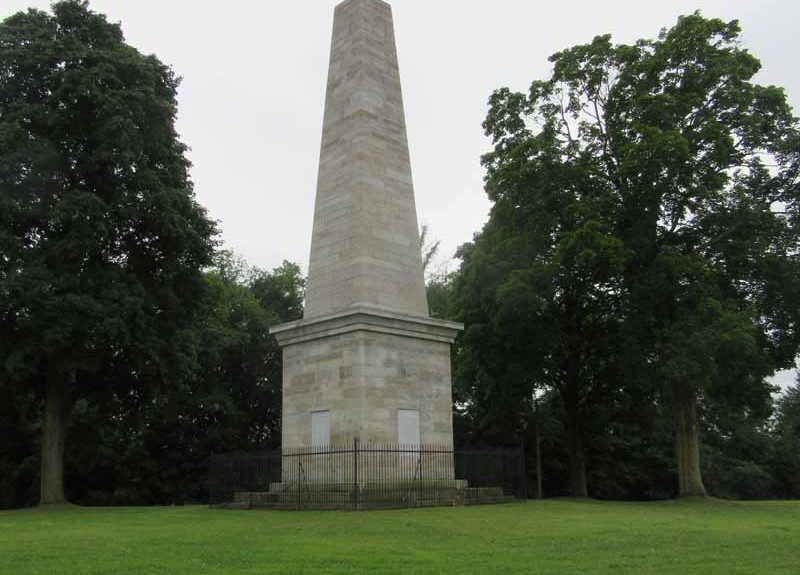
Didn’t really know that this existed until a few years ago when I was driving up US 11 on my way to Sabatini’s Bottle Shop and I passed a large monument. What was that for? I found out that a battle was fought here during the Revolution. Who knew? Obviously not me until I visited the area.
At the outbreak of the Revolution the British were worried that the French would use the conflict to move back into territory that they had lost following the French and Indian War. They did not know that the treaty negotiated between the Colonists and the French forbade that, but then what the British didn’t know could hurt them. Loyalists were recruited in Canada as well as hundred of Natives and placed under the command of Colonel John Butler who decided to invade the Wyoming Valley to chase out non-Loyalists. The Colonists were not sitting on their hands and were also recruiting Native allies convincing the Oneida and Tuscarora to join.
The British force began arriving in the area on June 28 and announced their arrival by killing 3 workers at a grist mill. A militia fort was forced to surrender and the garrison was released on the promise of never taking up arms against the Crown. They were not so persuasive at Forty Fort and Butler was weakened with part of his force operating against another fort with the Colonial militia moving to stop them. Butler decided to try something nasty. He set the militia fort on fire hoping to make the Colonials believe that he was retreating. Butler placed his rangers near the fort and told his Seneca allies to lie down out of sight. The militia, numbering about 300, advanced on Butler and right into his trap. 45 minutes later the battle was over and only 5 militiamen escaped alive. 227 miltiamen were killed outright and those captured were executed.
With his force severely weakened militia commander Nathan Denison surrendered Forty Fort and two other forts and were able to return home on the promise that they would not take up arms again against the crown. Denison and his men would not honor their parole and most would be killed within a year by the Iroquois.
Butler reported 3 killed and 8 wounded while claiming about 230 militia were killed and buried in a common grave. About 1,000 homes were destroyed. Reports of the execution infuriated the Colonial cause and prompted Denison and his men to return and fight the Natives. In 1779 an expidition led by John Sullivan entered the area and destroyed several Iroquios villages and the tribe never recovered from that with many dying of starvation over the winter. Fighting continued in the area until the end of the war. A monument was erected over the site of the mass grave and a smaller monument marks the location of the fort. Of course this battle follows the typical naming convention of the victors of the war. If the winners win it is a battle, if they lose it is a massacre.