As dawn broke on July 3 the Confederates found themselves in control of the Emmittsburg Road and the Wheatfield but staring up at Little Round Top. In the center they were exactly where they had began their day staring at Cemetery Ridge with only control of the Bliss Farm to show for it. On Culp’s Hill they controlled the lower portion of the hill but had been unable to take the upper part of the hill or advance any further. That night the XII Corps had returned and took position to contain the Confederate gains. The left was bolstered with reinforcements from the newly-arrived VI Corps and was now too strong for the Confederates to break through. Big Round Top had been taken overnight with barely a shot being fired so the Union now controlled the high ground. The flanks were strong.
Lee believed that center must be weak. He considered simply resuming the assault from the day before but Longstreet argued against it, his men were fought out and Pickett’s fresh division would not make a difference. Ewell however was also ordered to continue his assault at dawn but did not get updated orders. It did not matter anyway.
Culp’s Hill
Henry Slocum resolved to take his line back. As soon as the first rays of light peeked over the horizon (about 4:15 AM) his artillery opened fire. For eight continuous hours charge and counter-charge took place until Ewell’s men were driven from Culp’s Hill. Outside of a set of misinterpreted orders to recon the lower hill which resulted in two regiments making a forlorn assault, Culp’s Hill was carried with relatively little loss to Slocum. For Ewell, that was not true with George Greene reporting 400 dead bodies in front of his sector alone.
The Union line had been secured by the flooded a mill pond at the McAllister Mill. The mill today has long since been lost but it was a stop on the Underground Railroad and the mill pond still has some remnants. Union troops also crossed Rock Creek and Thomas Neill’s Brigade drove Confederate troops from the Stonewall Brigade on Wolf Hill back but did not press their advantage.
The Cavalry
The role the cavalry on both sides at the battle (outside of Buford on July 1) is largely ignored. There had been a small cavalry engagements at Hunterstown on July 2 which had been inconclusive. On July 3 one Union cavalry regiment was chewed up at Fairfield by Confederate cavalry. The largest engagement occurred near Bonneuville. J.E.B. Stuart was sent to try to get around the Union flank but no one really knows the true purpose of the mission. Was he to create confusion, was he supposed to get into the Union rear disrupting a retreat, was he just to engage the Union cavalry?
He pulled his men onto Parr’s Ridge and fired a cannon off. Most believe this was a signal to Lee that he was in position. It also alerted Union cavalry under David Gregg about a mile away. What resulted was saber and pistol charges that did very little to effect the outcome of the battle. Stuart was defeated, arguably for the first time in a fair fight. The Union cavalry had come of age and was no longer the pushover they had been a year ago.
Into Immortality
With Longstreet not believing he could carry out his assault Lee was forced to adjust on the fly. He was aware that Wright’s Brigade had broke the Union center and had controlled the field (they hadn’t in actuality but Wright believed he did) so if 1,500 men with no artillery or support could do it, what could 15,000 men with artillery do? Lee decided to find out. For Lee, he could not admit defeat. He could not come this far and turn back. He couldn’t do that to his men since he believed that they could carry any position after all.
A massive artillery bombardment would begin about 1:00 that would drive the Union troops off the ridge. When that was done the assault would move forward. Joining Pickett would be two other division, Heth’s Division now under Johnston Pettigrew and part of Pender’s Division now under Isaac Trimble. Both had been hit hard on July 1 and were chosen simply because they did not fight on July 2.
The bombardment began approximately 1:07. Smoke quickly obscured the field as the wind had died. The Confederates could not see that their shots were going long. The safest place in the Union center was on the ridge. Meade’s HQ about 500 yards behind the ridge was hit hard and Meade was forced to take shelter on Culp’s Hill. Hancock’s II Corps was taking almost no loss but to bump morale he ordered his artillery to open fire. Meade’s chief of artillery wanted to save ammunition for the assault but Hancock overruled him.
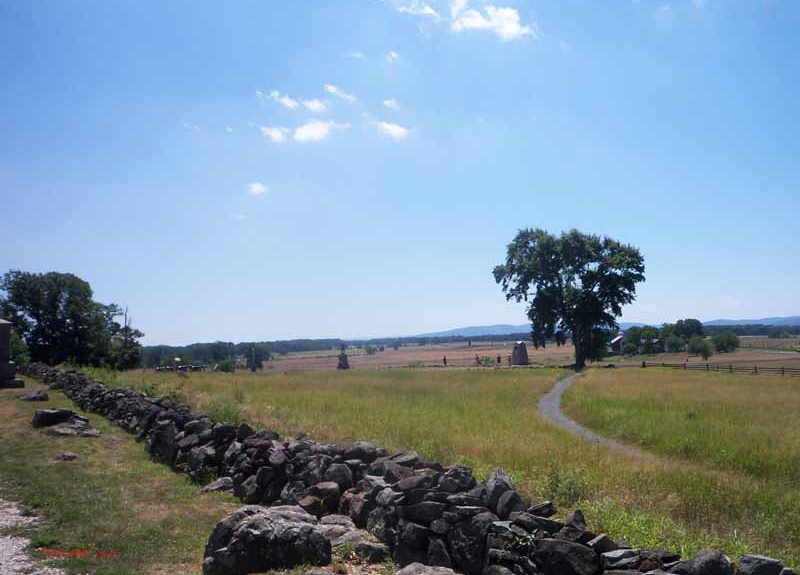
Eventually Hancock’s artillery ran out of ammunition and ceased firing. Because of the smoke this was the only gauge the Confederates had as to Union resistance. When it stopped the assault was ordered forward. When the smoke began to clear it was an awesome sight. Stretching for a mile with bayonets glinting in the sun it was a sight Union survivors never forgot. As it got closer Union batteries opened fire on it from Cemetery Hill and Little Round Top. The fences alone the Emmittsburg Road slowed them down and Hancock’s batteries opened with short range ammunition. Canister shot tore gaping holes the assault and Union forces got onto both of the flanks. Some Confederates began to flee but most continued on.
Some made it the 100 yards beyond the fence to the stone wall. About 125 made it over. All were shot or captured. Some took shelter behind the barn of Abraham Bryan (a local free black man, irony right?). Union reinforcements poured in from all angles but the assault was over and its survivors either surrendered or retraced their steps.
A Needless Loss
Sensing victory the Union cavalry commander Alfred Pleasonton decided he wanted to get some glory for himself. He ordered his cavalry on the southern end of the battlefield to make an assault mistakenly believing that the Confederates would be demoralized. They weren’t. One brigade fought dismounted and never made any headway. Another made a cavalry charge over ground not suited for it. The Confederates were not demoralized and it only added to the casualty lists.
The end
Gettysburg was the bloodiest battle the Western Hemisphere has ever witnessed. 23,000 Union and 28,000 Confederate casualties were a staggering amount. Units on both side were shells of their previous selves. Lee was now faced with no alternative but to retreat, which he did on the night of July 4. Meade pursued about as well as an army that had been marching 15-20 miles a day for two weeks, fought a major battle for 3 days and had not eaten a good meal for 2-3 days, could but Lee escaped back into Virginia on July 14. The war would continue.
For the civilians the problems were just beginning. Thousands of dead needed to be buried. Many farmers had their crops destroyed and there was not a scrap of food in the town. Wounded were being kept in many homes and churches. That would change when a general hospital east of town was opened called Camp Letterman. Civilian doctors came to lend a hand and most turned around after seeing the scope of the work. Surgeons worked without sleep in many cases for three days to amputate limbs and tend to wounds. Other civilian organizations like the Sanitary Commission provided food and material. The dead were buried where they fell.
An idea was put forth to create a cemetery for the Union dead. Those bodies were exhumed and moved in a painstakingly slow process to the cemetery. Confederate bodies remained where they lay. By the time the cemetery was dedicated in November there were still bodies being moved. This was the dedication where Abraham Lincoln gave his few appropriate remarks.
Several civilians died when unexploded ordnance exploded or when they were playing with discarded firearms. Union soldiers attempted to reclaim all government property and were ruthless about doing it. The penalty for being caught with government property was to have to bury dead horses for a day and there were a lot of dead horses, over 10,000 of them. This was something that the United States has never seen and has not seen since.