Union reinforcement arrive
Overnight Dan Sickels’ III Corps and George Sykes’ V Corps began arriving on the field. Winfield Hancock’s II Corps had arrived just before night on July 1. Only John Sedgewick’s VI Corps was not on the field but they were coming. For Lee only James Longstreet’s Corps was not on the field but they were only a few miles away near Marsh Creek. Meade himself arrived around midnight and immediately set about inspection the terrain and planning for defense.
The reconnaissance
Like any commander Lee wanted to have the most accurate intelligence in order to perfect a plan. He was probably pleased when he woke up and found that Meade was still in position. He sent one of his staff engineers along with one of Longstreet’s to find out what parts of the Union army was where. They avoided cavalry patrols and made it up onto a hill and saw nothing. No Union troops. When they returned and were questioned by Lee, who asked if they had gone onto the hill to be known as Little Round Top, they confirmed that they had and no Union troops were between the visible end on Cemetery Ridge and there. Lee decided to send Longstreet’s men on a flanking mission that would end the battle and quite possibly lead to independence. There was just one problem. The reconnaissance report was wrong. Sickles’ Corps was bivouacking in the low ground just north of Little Round Top and was visible from there. Hancock’s Corps was just behind Little Round Top. There were even Union troops on Little Round Top from Slocum’s Corps. Lee was about to attack with faulty intelligence.
Getting into position
Longstreet moved his men to Gettysburg and with the plan set he set his men in motion around noon. He wanted to wait for Evander Law’s Alabama brigade which was coming from Greenwood (modern Caledonia State Park) and would arrive around noon. When they arrived his corps went into motion. All was well until his men reached a small hill near the Black Horse Tavern. To get to the road that would get his men into position his men had to cross that hill which would make them visible to the Union observers on Little Round Top. Rather than taking another route that one of his artillerymen found Longstreet began a long and tedious counter march taking them back to the Chambersburg Pike and then down Knoxlyn Road to Old Mill Road which put them out behind the hill. Now they could move into position in secret. They arrived in place after nearly four hours of marching opposite the Joseph Sherfy’s Peach Orchard.
Dan Sickles strikes
Dan Sickles was an anomaly in the Army of the Potomac. He was not a professional soldier, instead he was a lawyer and politician. He was a womanizer who caught his neglected wife in an affair while he was a sitting Congressman and shot the man dead. The ensuing trial was unlike anything this nation had ever seen and his lawyers pioneered the temporary insanity defense and got him off. When the Civil War broke out he saw an opportunity to rehab his image and possibly win the presidency. George Meade did not like him and the feeling was mutual.
Two months before Gettysburg Sickles had been ordered to evacuate a position at Chancellorsville in Virginia and the Confederates immediately seized it and pounded his men with artillery. When Sickles gazed westward he saw the same thing. The high ground along the Emmittsburg Road looked much more tantalizing than the low swampy ground he was occupying. It gave him room to place his artillery (this position was an excellent artillery platform).
First Sickles had to find out if there was anything to his front. He sent parts of two regiments forward onto Seminary Ridge and a brief firefight ensued. Sickles maintained that he found Longstreet’s men but in reality he struck the end of Richard Anderson’s Division from Hill’s Corps that was waiting for Longstreet to get in line. Either way they found Confederates and that was all Sickles needed.
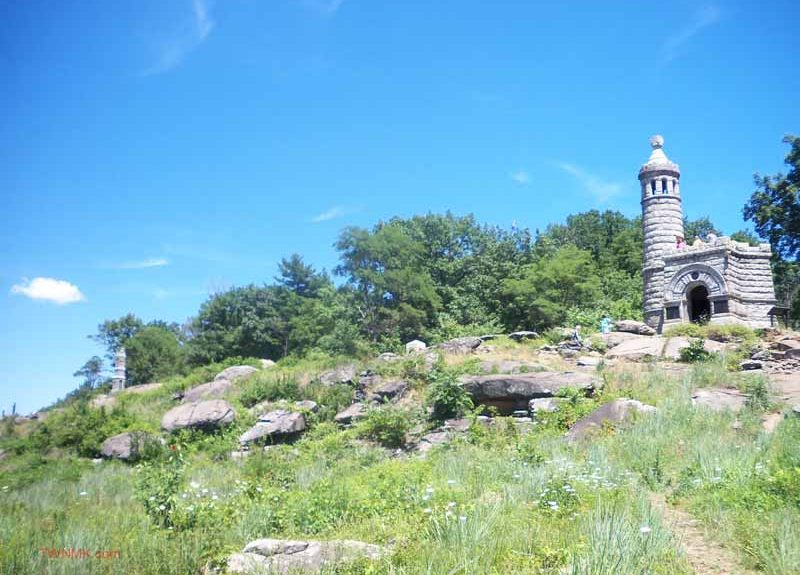
He moved one division forward first, placing one flank on a group of giant granite boulders, stretching through a woodlot and placing the other flank near the Peach Orchard. The other division moved forward shortly thereafter and took position along the Emmittsburg Road. When Meade heard this he was furious and rode out to see Sickles. It was now nearly 4:00 PM and Sickles offered to retreat. But Longstreet’s men were getting into position. Meade would have to make the best of a bad situation.
Longstreet attacks
James Longstreet was not expecting to find anything more than a few skirmishers to his front. He now found a Union force along the Emmittsburg Road in line of battle with artillery. Rather than now launching his attack in one massive column he moved his rear division under John B. Hood further toward the south. Led by Law’s Alabamians, who had been marching since about 4:00 AM and had not even had time to fill their canteens, the assault began after a brief artillery barrage. Hood was hit by shrapnel almost immediately and put out of action. His subordinates did not know the plan and Hood’s command fought their own battles.
The giant boulders known locally as the Devil’s Den was first hit. Union troops valiantly tried to hold the position but were overwhelmed. Law’s men tried to flank the rocks but found Union artillery in the valley behind which stopped them cold. More of Hood’s men moved toward George Rose’s Wheatfield and pushed Sickles’ men back there. Sickles’ position was crumbling.
Meade did not wait on his hands for this to happen. He ordered George Sykes’ to send reinforcements immediately from the V Corps and called up a brigade of artillery from his reserve to bolster the line. This artillery was instrumental in repulsing the Confederates first attack on the Peach Orchard. Hancock also sensed danger and readied his southernmost division to be ready to move. The call came and they were the first to arrive to bolster Sickles. John Caldwell’s division moved into the Wheatfield and pushed back Hood’s men, driving them out of the field, most of the Rose woodlot and the Stony Hill. Sykes’ men arrived soon after and began to take position on the Stony Hill. Except for one brigade.
Little Round Top
Sickles orders were to occupy and protect Little Round Top. Everyone seemed to see its importance except for Sickles himself, who argued that he was protecting it by fighting in front of it. Well, some of Law’s Alabamians were going around Sickles. Some of them went up Big Round Top, some went through the Slyder Farm but they were coming. Holding Little Round Top was a handful of signalmen and the chief engineer of the army, Gouverneur Warren. Warren saw Hood’s men coming and knew something had to be done. Fortunately he was a major general and had some pull. He sent staff officers (one was Washington Roebling) to the commander of the division of the V Corps that was being deployed to the Wheatfield asking for a brigade to hold Little Round Top. That courier could not find the man. Instead he found the commander of the last brigade waiting to be deployed, Strong Vincent. Vincent, on his own authority, asked to see the message and immediately ordered his men to head to Little Round Top.
Hood’s men arrived about ten minutes later. At first his men were repulsed but they tried again. The 15th Alabama kept trying to work around the 20th Maine on the far left. The 1st and 4th Texas forced the 16th Michigan to retreat in some confusion. As Vincent tried to rally them he was shot. With confusion reigning and ammunition running low it seemed that the Confederates could take the hill. But Warren had not stopped looking for reinforcements and now he found more V Corps troops waiting to be deployed and on his own authority diverted them to Little Round Top. The 140th New York led the charge and arrived at the nick of time driving the Confederates back. On the left, the 20th Maine executed its famous bayonet charge and cleared that end. Little Round Top and the Union left was safe.
Sickles’ line collapses
Chomping at the bit in the Pitzer Woods were the Mississippians under William Barksdale. Barksdale was an ardent secessionist and a true believer. Finally the time came for his men to begin their assault. Their assault was relentless. Sickles line in the Peach Orchard collapsed almost immediately. With that part of the line gone and reserves depleted the line along the Emmittsburg Road was forced to retreat. After changing hand seven times, Union forces in the Wheatfield were forced out. Here was the opportunity for the Confederacy to win.
Watching from his HQ at the Trostle House Sickles ordered a battery that was falling back to stop and go into battery to buy time. This battery, Bigelow’s, had never been in combat before that day. They fired everything they had to slow Barksdale’s men but were eventually overrun. But they bought time. Behind them a line of artillery was being organized to fill the gap. Winfield Hancock was sending more of his men to fill the now mile long gap in the Union line. For perhaps the best, Sickles took a cannonball to his leg and was carried off the field. Further reinforcements were on the way from the XII Corps but that would take time.
As Barksdale’s men continued their rampage all that stood in his way were the Union soldiers under George Willard. These men had been stationed at Harper’s Ferry in 1862 and were captured by Barksdale’s men when the town fell. They had been treated horribly by their own comrades while they were waiting to be exchanged, essentially being prisoners of war in their own lines. Now they were out to prove themselves. They went head on at Barksdale. Both Barksdale and Willard were shot down but the momentum of the assault was stopped.
Further up the line Alabamians under Cadmus Wilcox and Foridians under David Lang were also heading for the gap. All that was left in their way was the 1st Minnesota, 262 men. Hancock himself ordered them to charge to buy 10 minutes while he got reinforcements. They did and lost 80% of the regiment but again the Confederate assault was blunted.
Cemetery Ridge
Continuing the assault further up the line was a brigade of Georgians under Ambrose Wright. They advanced across an open field toward Cemetery Ridge. They pushed aside weak resistance along the Emmittsburg Road and moved on toward the top of the ridge. Chaos reigned around them as nothing seemed to be able to stop them. George Meade himself with his staff seemed to be all that was in between Wright and the Union rear. Meade drew his sword and was going to charge with his escort when infantry from the I Corps arrived. Hancock’s men were also beginning to push Wright back and stabilize the situation. Wright claimed later that he was master of the field and if had been supported the war would have been over. His support, Carnot Posey’s Mississipians had never come up. They had stopped at the Bliss Farm and were content with occupying that. Wright’s claims would have disastrous consequences the following day and in actuality he never pierced the main Union line along Cemetery Ridge only an advanced line along the Emmittsburg Road.
Culp’s Hill
When XII Corps occupied Culp’s Hill in the morning and afternoon of July 2 they held a strong position. On the summit George Greene’s New York brigade began building field entrenchments and everyone else followed suit. This was looked down upon as fighting behind a barrier was not considered manly but the fate of the country was on the line. This sector was quiet through the day. This was not because there were no Confederates opposite them but because they were waiting for Longstreet. Richard Ewell was under orders to demonstrate against Culp’s Hill with the option to make an attack if the opportunity arrived. The only thing he tried was an artillery bombardment around 4:00 PM which was pummeled by Union artillery. Around 7:30 that opportunity arrived. The XII Corps was called to reinforce Sickles crumbling line.
Something was lost in translation. Only one division was to be sent but Henry Slocum ordered both divisions to go. George Greene pleaded to be allowed to remain. Culp’s Hill controlled the Baltimore Pike, which was the army’s direct link to its supply line in Westminster, Maryland. It was a macadamized road so it could handle the heavy army wagons and was not as susceptible to the rain as dirt roads, and it had been extremely rainy lately. Greene was allowed to stay.
Alpheus Williams’ division moved toward the fighting. John Geary’s continued down the Baltimore Pike and off the battlefield. After crossing Rock Creek they realized that they were lost and halted until they could figure out where they should be. By then it was dark and the Union left was safe. It would have been better if they had stayed put.
As soon as Ewell realized Union troops were pulling out he launched an attack. His men took the lower entrenchments but darkness stopped the attack. If only they knew how close they were, about 500 yards from the Baltimore Pike. They could hear the army wagons and misinterpreted the noise to mean the Union was retreating. Further up the hill Ewell’s men ran into Greene’s. Greene called for help and got it from I Corps, II Corps and XI Corps who bolstered the line. The Confederates were never able to drive Greene and his help off.
Cemetery Hill
The key to the Union line was Cemetery Hill and Oliver Howard’s XI Corps held this, simply because this was where they had rallied the day before. Howard did not trust his men and this night proved him right. Jubal Early’s Division began its assault around dusk. His men got to the brow of the hill driving Howard’s men away. Greenleaf Steven’s Battery held a small knoll hitting Early’s men in the flank and Michael Weidrich’s Battery fought hand to hand with Early’s men for their battery. But coming up in their rear were troops. Who’s were they, as it was now dark. The firing had died out to the south. Did that mean that Longstreet and Hill had succeeded and they were now coming up in the Union rear? The troops fired a volley and Early’s men saw the Stars and Stripes. It was Samuel Carroll’s brigade who, as he had done all day, Hancock had ordered to move in anticipation of problems. Carroll’s men charged and Early was forced back.
Stay and fight it out
The Union line was battered and beaten but had held. Meade held a council of war at his headquarters and found his subordinates were resolved to stay and fight it out. Meade himself had to be exhausted as he had not slept since he took command of the army and it would be doubtful that he could get any sleep now. For Lee he had forced the Union from a strong position but was unable to finish the job on the southern end of the battlefield and had nearly broken the Union line on the northern end. He had fresh reserves in George Pickett’s Division and his long lost cavalier J.E.B. Stuart had finally arrived. But the Union too had reinforcements, John Sedgewick’s VI Corps, the largest in the army, had arrived after a 30 mile forced march.
Meade and his generals resolved to stay and fight it out.