After fighting ended at the Wilderness and Spotsylvania Court House both the Union Army of the Potomac and the Confederate Army of Northern Virginia were exhausted. With another stalemate Grant decided to continue to move to the south around Lee’s right to try to get between Lee and Richmond. Grant had about 68,000 men after the two battles and the loss of the regiments who’s enlistments had expired. Lee had about 53,000 men but he had nearly fought Grant to numerical equality.
Grant wanted to move 25 miles south to the North Anna River and Hanover Junction, an important railroad junction in the area. If he could seize these he hoped to disrupt Lee’s supply line and take from them the use of the next logical defensive line. But Lee was closer to the North Anna so he could beat Grant there so Grant devised a ruse. Winfield Hancock’s II Corps would head toward Milford Station to the southeast hoping Lee would follow both distracting Lee and taking men away from his army.
Hancock moved on in the evening of May 20. When his men approached Milford Station the following day he found Confederate soldiers there. They were on their way to join Lee and not stationed there but Hancock had not expected to find any Confederates and paused. His corps easily took control of the town but he believed that Lee was moving against him and stopped the move. Hancock’s move had Lee in the dark and he did not want to disengage from Spotsylvania in the face of Grant but Grant made his decision for him and began moving his men out on May 21.
With Union troops again making trouble in the Shenandoah Valley John Breckenridge’s Division was being sent back to that place. Lee intercepted it and moved it to the North Anna River instead, the Valley would have to wait. Richard Ewell’s Corps was moved to block Grant’s march and a change in route was made. By now Lee had figured out what Grant was doing and put his army in motion. On the night of May 21 Gouverneur Warren’s V Corps and much of Lee’s army camped within a mile of each other with both sides oblivious to the other’s presence.
North Anna
Lee’s men reached the North Anna River the following day. Grant knew he lost the race and allowed his men to get some needed rest while Lee’s men took up positions along the crossings of the river. Hancock forced his way across the river at Chesterfield Bridge on May 23 and Warren found the crossing at Jericho Mills unguarded but was hit by A.P. Hill’s Corps and was thrown back briefly. Hill’s attack lacked punch as it was stopped by Warren’s artillery and a few regiments of infantry and the crossing continued. Lee was not happy with Hill’s performance.
Horatio Wright’s VI Corps could follow Warren and now three Union corps could be arrayed against the Confederate left. Hancock and Ambrose Burnside’s IX Corps opposed the Confederate right. Rather that retreating from the North Anna Lee had his chief engineer create a strong defensive line. Entrenchments were dug to create an inverted V with the point up against the North Anna River. Grant would be unable to bring his entire army to bear at any one point and the river separated his two wings by 10 miles.
On the morning of May 24 Union troops came astride of the Virginia Central Railroad. Grant’s entire army was across the river and he believed that Lee had fallen back and was preparing to pursue rather than for battle. Lee had other ideas and had prepared a trap for Grant’s right. On Grant’s left Burnside’s corps was the first to hit the Confederates. His lead brigade under James Ledlie attacked the position alone and was repulsed with heavy losses. Ledlie had a reputation for being drunk in the field and had been ordered not to attack until the entire division was across the river. Despite this he would be given a division shortly after, such was how the IX Corps operated.
On the Confederate left Hancock moved to attack just as Lee was hoping. He could potentially deliver a blow that Grant would not be able to recover from but now Lee began to break down from the hard campaigning. He became bedridden with diarrhea and was unable to do anything. He had no logical successor. James Longstreet, his senior corps commander, had been wounded at the Wilderness. Richard Ewell was exhausted after Spotsylvania. A.P. Hill was incapacitated with a lingering illness that he suffered from since his days at West Point. J.E.B. Stuart, his trusted cavalry commander, had been mortally wounded at Yellow Tavern a few days before. His last corps commander, Richard Anderson was too new to the job. No one could coordinate a counter attack and the opportunity slipped away.
Hancock advised Grant that Lee’s defenses were strong. In the evening he called a halt and ordered his men to entrench. On May 25 Warren probed the Confederate position but found it too strong. Wright moved to flank the position but was blocked by Wade Hampton’s cavalry. Grant was loathe to send his men against entrenched Confederate soldiers and believed that since Lee did not attack him that Lee was whipped. That was nowhere close to the truth but Grant did not know that yet.
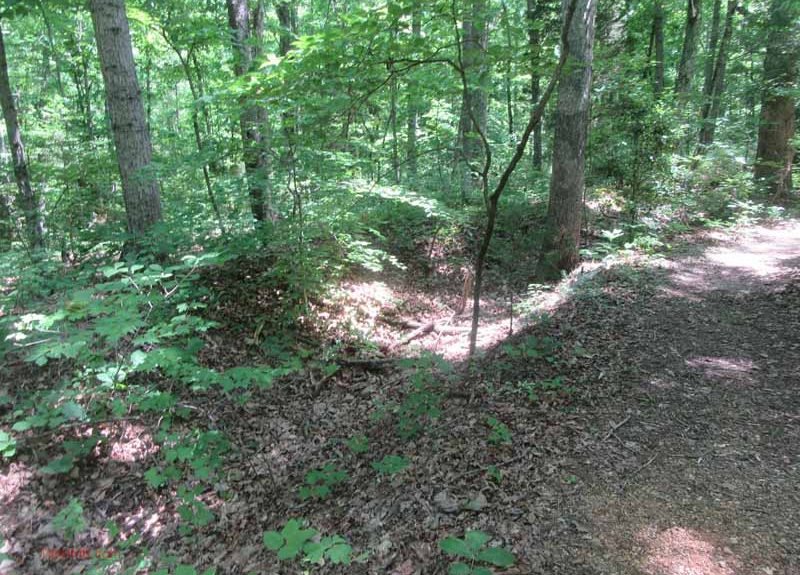
Despite the potential for a major engagement North Anna was a small battle. Grant lost about 2,600 men. Lee lost somewhere between 1,500 and 2,000 men. The battlefield has been preserved as part of North Anna Battlefield Park and offers two trails, one following the Union attack and one following the Confederate defenses.
Totopotomoy Creek
Grant now moved again to Lee’s right. He continued moving southeast along the Pamunkey River and again was looking for a place to get at Lee. Grant’s cavalry secured a ford and his infantry crossed the river on May 27. A cavalry fight the following day at Haw’s Shop gave Lee the insight needed to make his next move to counter Grant. Lee called for reinforcements from south of the James River but they would not arrive in time for the next battle.
On May 29 Hancock found Lee’s men entrenched around Totopotomoy Creek. Warren and Wright moved in and crossed the creek to aid Hancock and Burnside was kept in reserve. Lee’s line from left to right consisted of Hill’s Corps, Breckenridge’s Division, Anderson’s Corps and Early’s (Ewell’s) Corps.
The following day Grant ordered a forward move. Little progress was made outside of the capture of a few rifle pits and the assault bogged down. Lee by now had recovered from his North Anna illness and ordered Early to assault Warren with the help of Anderson. One division under Robert Rodes would be sent on a flanking march and hit Warren’s left. Warren was worried for his left and moved a division to guard it but he picked the wrong force to do so. Samuel Crawford’s division was made up of new soldiers and veteran soldiers whose enlistments were about to expire and despite the solid combat reputation of the Pennsylvania Reserves it was a shaky and unreliable outfit.
The Confederate flanking attack routed Crawford’s men with ease but Rodes lost control of his men. The plan called for him to move into Warren’s rear but when he did get control of his men their assaults were repulsed by the now vigilant Union defenders and heavy losses inflicted on two brigades. Anderson and his support was nowhere to be found and the attack petered out. Meade, believing that Warren was in trouble, ordered an assault all across the lines but no one was in position to do so and did not go forward.
Another stalemate forced another move. Casualties here were light. The Union lost about 700 men and the Confederates lost about 1,600. Lee was now informed that Union reinforcements were coming to Grant from south of the James and would be able to threaten Lee’s right from the crossroads near Cold Harbor. Lee sent his cavalry to slow their march. The situation was getting worse.
Not much of this battlefield is preserved. What is preserved is centered around Rural Plains, the home of Patrick Henry, and located near where Hancock attacked as a unit of the Richmond National Battlefield.