I had visited here in 1996 and during the government shutdown. Being 13 I don’t remember a lot but I do remember seeing Fort Sumter from The Battery. Couldn’t go out to it though. It wasn’t until 2016 that I made my way back and I have rarely been as excited as I was that day to visit somewhere.
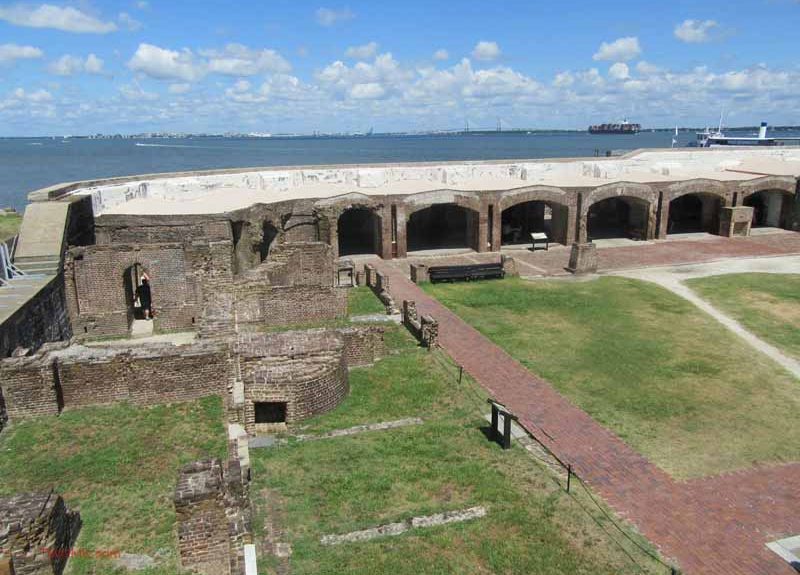
Forts Sumter and Moultrie
There are two forts remaining in the Charleston-area, Sumter and Moultrie. Moultrie was the first to be constructed to guard Charleston Harbor in 1776. It was here that the Colonial cause won an early victory when the Royal Navy unsuccessfully attacked Charleston. The fort was eventually taken by the British in 1780 and abandoned in 1782. By 1800 the fort was decaying and a new fort was built. This design was still used by the time the Civil War came around.
The fort itself faces out to sea and provides no protection from a land attack. Amongst a hostile population Moultrie would be useless. The garrison commander petitioned the Secretary of War for reinforcements but his requests were ignored. The Secretary of War, John Floyd, planned to simply hand the forts over to South Carolina and join the Confederacy himself. The fort itself was evacuated by US troops on December 26, 1860 and the garrison transferred to Sumter. The fort was immediately seized by South Carolina and was held by the Confederacy throughout the war until abandoned in 1865.
Sumter was built to protect the Charleston Harbor from a man-made island in the harbor. Construction began in 1829 but was unfinished by the time South Carolina seceded and for the most part was obsolete and only half of the cannons had been mounted because of the lack of funds. The post commander, Robert Anderson, was urged to surrender the fort by both the governor of South Carolina and the military commander P.G.T. Beauregard. Beauregard was a former student of his at West Point. Anderson knew that supplies could not last and the garrison of 125 men could not last long when they ran out.
An attempt to resupply his garrison was turned back by artillery fire from the South Carolina Militia in January. In April, with food reserves dwindling Abraham Lincoln tried again. The South knew they were coming, Lincoln told them after all, and they opened fire on the fort at 4:30 AM on April 12, 1861. Anderson had refused to surrender the fort the day before and Beauregard felt he had no other options. Fireeater Edmund Ruffin took the honor of firing the first shot for South Carolina. The Civil War had begun. Fire came from all around Charleston and hit the fort hard. Legend has it that Abner Doubleday, a captain in the artillery fired the first shot for the Union. On April 13 the fort surrendered. No one had died inside of the fort and one Confederate died when a cannon misfired. The fleet that was coming to resupply the fort instead took the garrison away. It was hoped that this was all that would be needed to secure Southern independence but it wound up only increasing Northern resolve and led to most destructive war North America has ever witnessed.
The Confederates held the fort all throughout the war, despite multiple Union efforts to seize it. It was a powerful symbol and each attempt was turned back. The forts around Charleston were never seized but the Union blockade proved to be just as effective. The fort was abandoned in 1865 when William T. Sherman marched through the Carolinas. When the war ended Anderson was invited back as an honored guest to raise the same flag that he had taken down over the fort.
Both forts were used after the war but more for observation than for defense. Modifications done during World War 1 and World War 2 are still visible on both. The other forts in Charleston are gone. Fort Wagner was swallowed by the sea, Castle Pinckney is abandoned and at the mercy of the harbor, and Fort Johnson is now a state-owned research facility. Sumter and Moultrie are preserved as a part of Fort Sumter National Monument.